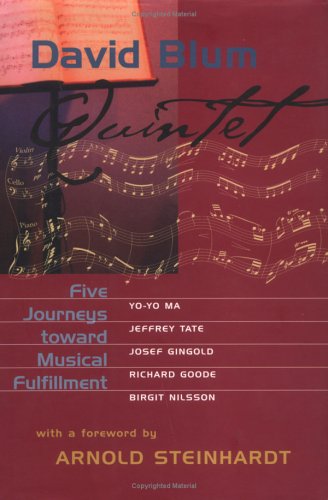
Quintet gathers five of these profiles (from the late '80s and early '90s): Yo-Yo Ma, Jeffrey Tate, Josef Gingold, Richard Goode, and Birgit Nilsson. Each portrait reveals Blum's uncanny ability to enter into the confidence of his subjects. He seems to blend the skills of a trusted therapist with the insight of an avid music lover in getting beyond their safeguards and letting them speak from an unusually intimate perspective. Blum conveys their unique world-views through arrestingly apt images, often coaxed directly from the musicians themselves. We find Yo-Yo Ma comparing Beethoven to a topnotch comic since both share "superb timing," while Richard Goode labels the piano "the great instrument of illusion." Blum also has a gift for elegant, lapidary formulations that go to the heart of the matter, as in his assessment of the encyclopedic knowledge of legendary violin pedagogue Josef Gingold: "Perhaps Gingold's most valuable service as a mentor is to heal the artistic division between technique and expression, between matter and spirit."
Blum's profiles go beyond in-depth interviews and actually reveal several levels, including a beautiful sense of proportion and structure in themselves. You can read them as compact little biographies that unfold with leisured ease, as essays in the relation of self-knowledge to artistic mastery, and as dazzling commentaries on particular pieces seen from within the musician's mind. Utterly lacking in pretension or pedantic analysis, Blum's style goes well beyond truisms and gives us new insights into such works as Bach's Cello Suites, Schubert's last piano sonatas, or Tristan und Isolde. There's plenty of humor here, along with painful acknowledgement from the musicians of the terrors of insecurity. The humanity that Blum reveals gives his portrayals a far-ranging appeal, in a style one could only hope arts journalists might look to as a model. --Thomas May