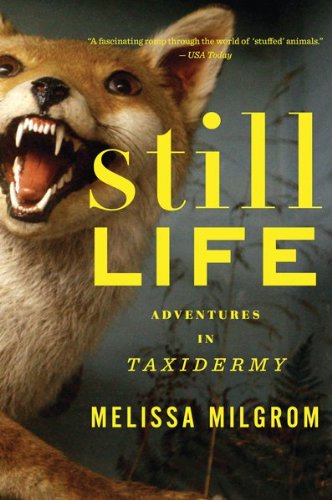
Amazon Exclusive: A Letter from Melissa Milgrom, Author of Still Life: Adventures in Taxidermy
Dear Amazon Reader,
People--even my own parents!--ask what sparked my interest in taxidermy. I tell them that in 1994 I went on a safari gone awry, which led me to the family workshop of the last chief taxidermist of the American Museum of Natural History. I was expecting him to be creepy like Norman Bates in Psycho, but he was a gentle naturalist, and his studio with its skeletons and birds, the beauty and the strange tools, evoked Darwin's study. The contradiction pulled me in, and still does.
Still Life took more than six years to write and that's because I had to shift my perception from one of skepticism to one of empathy and respect. I just saw Fantastic Mr. Fox and thought if Wes Anderson had been alive in the 1850s he'd have been a Victorian taxidermist, making little scenes of kittens dressed as brides. It's ironic--Victorians needed taxidermy to see exotic species from other continents, and we need taxidermists for the same reason--we long for animals as they disappear. Taxidermy evokes grandeur, which may help us comprehend the present mass extinction.
Another reason I find taxidermy engrossing is because it combines art, science, and hunting. In Still Life I shadowed the most gifted taxidermist I could find in each area: an artist, a field naturalist, and a hunter, each of whom is on a quest to understand nature on its own terms. English sculptor Emily Mayer preserves animals for Damien Hirst's most provocative artworks; her dogs are so boggling you have to poke them to see if they will move. Ken Walker, the hunter from Alberta who recreates extinct species, is self-taught. He won the World Taxidermy Championships three times and was a Roy Orbison impersonator, which actually makes perfect sense. Taxidermy is like karaoke. The person who loves the singer the most gets the voice right.
I hope you will enjoy the people you meet in Still Life whose obsessions and uncannily lifelike replicas create an art form that once was sublime and may be again.
Melissa Milgrom(Photo © Ulalume Zavala)
A Look Inside the World Taxidermy Championships with Author Melissa Milgrom
(Click to Enlarge)
Ken Walker's Panda "Thing Thing"--recreated from bear skins-- Best of Show Recreations 2003