This book embodies a course given by the writer for a number of years in the Mathematical Laboratory of the Massachusetts Institute of Technology. It is designed as an aid in the solution of a large number of problems which the engineer, as well as the student of engineering, meets in his work. In the opening chapter, the construction of scales naturally leads to a discussion of the principles upon which the construction of various slide rules is based. The second chapter develops the principles of a network of scales, showing their application to the use of various kinds of coordinate paper and to the charting of equations in three variables. Engineers have recognized for a long time the value of graphical charts in lessening the labor of computation. A mong the charts devised none are so rapidly constructed nor so easily read as the charts of the alignment or nomographic type a type which has been most fully developed by Professor M. d Ocagne of Paris. Chapters III, IV, and Vaim to give a systematic development of the construction of alignment charts; the methods are fully illustrated by charts for a large number of well-known engineering formulas. It is the writers hope that the simple mathematical treatment employed in these chapters will serve to make the engineering profession more widely acquainted with this time and labor saving device. Many formulas in the engineering sciences are empirical, and the value of many scientific and technical investigations is enhanced by the discovery pi the laws connecting the results. Chapter VI is concerned with the fitting of equations to empirical data. Chapter VII considers the case where the data are periodic, as in alternating currents and voltages, sound waves, etc., and gives numerical, graphical, and mechanical methods for determining the constants in the equation. When empirical formulas cannot be fitted to
(Typographical errors above are due to OCR software and don't occur in the book.)
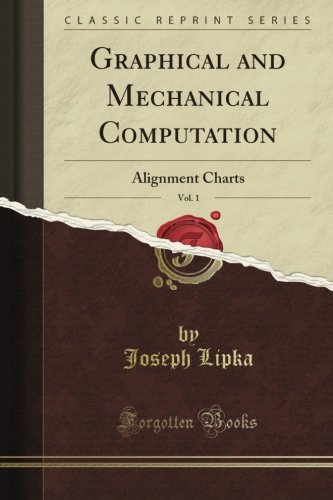
Graphical and Mechanical Computation: Alignment Charts, Vol. 1 (Classic Reprint)
📄 Viewing lite version
Full site ›
Book Details
Author(s)Joseph Lipka
PublisherForgotten Books
ISBN / ASINB009CF4FZU
ISBN-13978B009CF4FZ1
AvailabilityUsually ships in 24 hours
Sales Rank15,764,053
MarketplaceUnited States 🇺🇸