This publication gives you the information you need to determine the tax treatment of your pension and annuity income under the General Rule. Generally, each of your monthly annuity payments is made up of two parts: the tax-free part that is a return of your net cost, and the taxable balance.
What is the General Rule. The General Rule is one of the two methods used to figure the tax-free part of each annuity payment based on the ratio of your investment in the contract to the total expected return. The other method is the Simplified Method, which is discussed in Publication 575, Pension and Annuity Income.
Who must use the General Rule. Use this publication if you receive pension or annuity payments from:
1. A nonqualified plan (for example, a private annuity, a purchased commercial annuity, or a nonqualified employee plan),
2. A qualified plan if:
a. Your annuity starting date is before November 19, 1996 (and after July 1, 1986), and you do not qualify to use, or choose not to use, the Simplified Method, or
b. You are 75 or over and the annuity payments are guaranteed for at least 5 years (regardless of your annuity starting date).
The following are qualified plans.
• A qualified employee plan.
• A qualified employee annuity.
• A tax-sheltered annuity (TSA) plan or contract.
If you cannot use the General Rule. If your annuity starting date is after November 18, 1996, you must use the Simplified Method for annuity payments from a qualified plan. This method is covered in Publication 575.
If, at the time the annuity payments began, you were at least 75 and were entitled to annuity payments from a qualified plan with fewer than 5 years of guaranteed payments, you must use the Simplified Method.
Topics not covered in this publication. Certain topics related to pensions and annuities are not covered in this publication. They include:
• Simplified Method. This method is covered in Publication 575. That publication also covers nonperiodic payments (amounts not received as an annuity) from a qualified pension or annuity plan, rollovers, special averaging and capital gain treatment of lump-sum distributions, and special additional taxes on early distributions, excess distributions, and excess accumulations (not making required minimum distributions).
• Individual retirement arrangements (IRAs). Information on the tax treatment of amounts you receive from an IRA is included in Publication 590, Individual Retirement Arrangements (IRAs).
• Life insurance payments. If you receive life insurance payments because of the death of the insured person, get Publication 525, Taxable and Nontaxable Income, for information on the tax treatment of the proceeds.
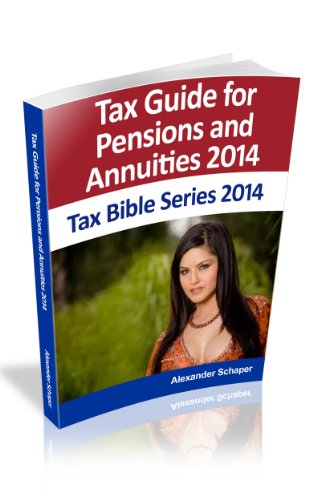
Tax Rules for Pensions and Annuities 2014 (Tax Bible Series 2014)
📄 Viewing lite version
Full site ›
⌛ 🇨🇦 Canada pricing being fetched…
Prices will appear once fetched — usually within a few minutes.
View in:
🇺🇸 USA
Book Details
Author(s)Alexander Schaper
Publisherirspubs.com
ISBN / ASINB00AI6MHN4
ISBN-13978B00AI6MHN6
MarketplaceCanada 🇨🇦