This comprehensive ebook provides authoritative information and practical advice from the nation's health experts about Raynaud's phenomenon. Starting with the basics, and advancing to detailed patient-oriented and physician-quality information, the 21st Century Sourcebook series gives empowered patients, families, caregivers, nurses, and physicians the information they need to understand this disorder.
Subjects and topics covered include symptoms, outlook, causes, who is at risk, diagnosis, tests and procedures, treatment, research, clinical trials, and more.
This edition includes our exclusive Guide to Leading Medical Websites with updated links to 81 of the best sites for medical information, which let you quickly check for updates from the government and the best commercial portals, news sites, reference/textbook/non-commercial portals, and health organizations.
Contents include: Part 1: Raynaud’s Phenomenon * Part 2: Vasculitis * Part 3: NIH Autoimmune Disease Research * Glossary of Clinical Trials Terms * Guide To Leading Medical Websites - Internet Resources for Medical and Health Information
Raynaud’s phenomenon is a condition that affects the blood vessels in the extremities—generally, the fingers and toes. It is characterized by episodic attacks, called vasospastic attacks, in which the blood vessels in the digits (fingers and toes) constrict (narrow), usually in response to cold temperatures and/or emotional stress. When this condition occurs on its own, it is called primary Raynaud’s phenomenon. When it occurs with another condition such as scleroderma or lupus, it is called secondary Raynaud’s phenomenon. Although people of any age can have Raynaud’s phenomenon, the primary form typically begins before the age of 30. Women are more likely than men to have Raynaud’s phenomenon. It appears to be more common in people who live in colder climates. This is likely true because people with the disorder have more Raynaud’s attacks during periods of colder weather. Studies suggest that 3 to 12.5 percent of men and 6 to 20 percent of women report symptoms of Raynaud’s phenomenon. For most, the symptoms are mild and not associated with any blood vessel or tissue damage. Most people with Raynaud’s phenomenon have the primary form, which is not associated with any underlying disease. In fact, in these individuals it is thought to be an exaggeration of normal responses to cold temperature and/or stress. When Raynaud’s phenomenon is caused by or associated with an underlying disease, it is referred to as secondary Raynaud’s phenomenon. Secondary Raynaud’s phenomenon tends to begin later in life than the primary form.
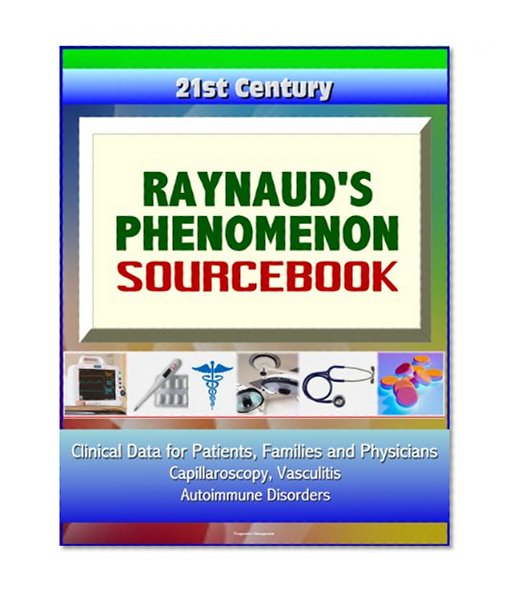
21st Century Raynaud's Phenomenon Sourcebook: Clinical Data for Patients, Families, and Physicians - Capillaroscopy, Vasculitis, Autoimmune Disorders
📄 Viewing lite version
Full site ›
Price not listed
🛒 Buy New on Amazon 🇺🇸
Book Details
PublisherProgressive Management
ISBN / ASINB00FG3WGG2
ISBN-13978B00FG3WGG9
Sales Rank1,947,853
MarketplaceUnited States 🇺🇸