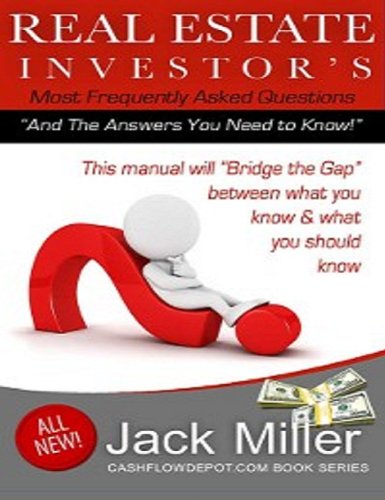
Real Estate Investors Frequently Asked Questions - Jack Miller - Real Estate Investor Training
📄 Viewing lite version
Full site ›
Price not listed
🛒 Buy New on Amazon 🇺🇸
Book Details
Author(s)Jack Miller
PublisherCashFlowDepot Books
ISBN / ASINB00FNKMH8K
ISBN-13978B00FNKMH88
Sales Rank99,999,999
MarketplaceUnited States 🇺🇸
Description ▲
I've written this Q & A Manual in an attempt to help bridge the gap between what you know and what you should know. The questions in the following pages were gleaned from among thousands that have been asked by people just like you in seminar after seminar over the past 18 years. The answers are based upon over 40 years of successful single family house investment and management experience. I hope they lead you to as fruitful a career and financial security as they have me.
There's no such thing as a risk-free existence. Everything we do or don't do carries with it the risk that we've made a bad decision. In order to move ahead of the crowd, you have to take a calculated risk, placing your hard earned cash on the line time after time without being certain of the outcome. It's almost impossible to reap uncommon rewards which place you financially well above the average wage earner without risking losses in equal proportion. I ought to know.
I've probably made as many mistakes and lost as much money as anyone in the real estate investment business. Fortunately, each time I've made a mistake, I've treated it as a small but expensive seminar and tried to learn from it. Consequently, I've tried to not only avoid making the same mistake again, but to capitalize on what I've learned by changing what I do in order to turn yesterday's loss into tomorrow's gain.
One of the things I learned over the years was that a single family house offers less risk and more reward for those with less skill and experience than virtually anything else in the real estate field. Financing, acquisition, management, maintenance and liquidation is easier. Opportunity is more wide spread. Choice is broader and more varied. Demand is more consistent, tax treatment more benign, and the learning curve more gentle than with anything else I can find. It but remains for the reader to get started along the yellow brick road to success.