CONTEMPORARY ATTITUDES TOWARD MIRACLES embrace two extremes. On the one hand, secular skeptics reject miracles outright. The scientific community, for example, has been dominated for two centuries by an incorrigible antisupernaturalism. Many insist that belief in the supernatural is part of an outmoded worldview that has been disproved by scientific research. Biblical miracles are classed along with the now discredited belief that tornadoes, hurricanes, eclipses, and earthquakes were miraculous because they could not be explained scientifically.
Typical of the scientific attitude toward the supernatural is the decision of Judge William Overton in the famous Scopes II trial in Little Rock, Arkansas: “Indeed, creation of the world ‘out of nothing’ is the ultimate religious statement because God is the only actor. Such a concept is not science because it depends upon supernatural intervention which is not guided by natural law. It is not explanatory by reference to natural law, is not testable and is not falsifiable.†A Smithsonian article characterizes the scientific distaste for the supernatural view of origins: “the central axiom of our epic is that the universe must have been formed by natural laws which are still discoverable today.â€
The author of the Declaration of Independence, Thomas Jefferson, reflects the antisupernatural disposition of the modern mind when he declares of the virgin birth that “The day will come when the account of the birth of Christ as accepted in the Trinitarian churches will be classed with the fable of Minerva springing from the brain of Jupiter.†Indeed, Jefferson cut all the miracles out of the Gospels and the results were published as The Jefferson Bible. It ends with these words: “Now, in the place where he was crucified, there was a garden and in the garden a new sepulchre, wherein was never man yet laid. There laid they Jesus, and rolled a great stone to the door of the sepulchre, and departed." The resurrection was excluded.
On the opposite extreme, there is a current revival of occult “supernaturalism†in new age healings, revelations, firewalking, and crystal power. Many gurus, channelers, mediums, shamans, and witches lay claim to the supernormal power of the Force.
A growing number of evangelicals believe that miraculous healings and even resurrections like those in the Bible still occur today. They make claims like “Today we see hundreds of people healed every month in Vineyard Christian Fellowship services. Many more are healed as we pray for them in hospitals, on the streets, and in homes. The blind see; the lame walk; the deaf hear. Cancer is disappearing.â€
Whatever the outcome of the intramural dispute among Christians about the status of miracles today, the whole question of the supernatural has a serious impact on biblical Christians of all stripes. For historic evangelical Christianity is at its heart thoroughly based in the Scripture, which is filled with miraculous events.
Indeed, the Bible itself cannot be a supernatural revelation, as it claims to be, unless there are supernatural acts. Neither can we trust the Gospels to provide reliable information about Christ, the central figure of the Christian faith, since they are replete with miraculous events repugnant to the modern mind.Indeed, since the credibility of Christianity rests on the resurrection of Christ (1 Cor. 15:12-19), the whole of the orthodox Christian faith crumbles if miracles do not occur. If historic biblical Christianity is to survive and make sense to the modern mind, it is necessary to provide a reasonable explanation of the supernatural. Apart from the credibility of the biblical account of miracles, we can bid farewell to orthodox Christianity. Such is the challenge before us.
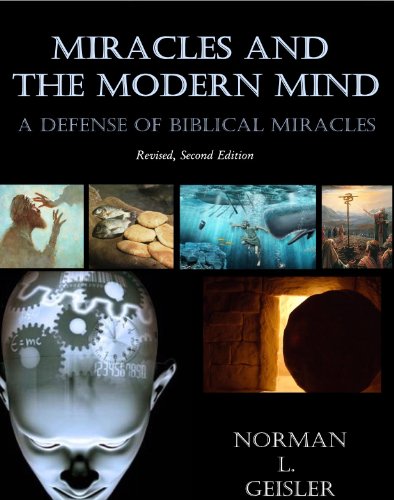
Miracles and the Modern Mind: A Defense of Biblical Miracles
📄 Viewing lite version
Full site ›
Price not listed
🛒 Buy New on Amazon 🇺🇸
Book Details
Author(s)Norman Geisler
PublisherBastion Books
ISBN / ASINB00G9B63MS
ISBN-13978B00G9B63M4
Sales Rank654,616
MarketplaceUnited States 🇺🇸