1. Goal. Outline a method of trauma resuscitation in which fluids, blood products and other adjunctive measures, e.g., Tranexamic Acid and Recombinant Factor VIIa (rFVIIa), are used to reverse or prevent coagulopathy and aid in management of ongoing hemorrhage.
2. Background.
a. Utilizing the Tactical Combat Casualty Care (TCCC) guidelines, medics and corpsmen
use tourniquets and hemostatic dressings to treat most compressible hemorrhage on the
battlefield. Non-compressible (truncal) and non-tourniquetable (axillary, neck, and
groin) hemorrhage remains a largely unsolved problem, and is the leading cause of
potentially preventable death on today’s battlefield.1
b. Following Advanced Trauma Life Support guidelines, physicians have traditionally
initiated resuscitation with large-volume crystalloid infusion, followed by the addition of
pRBCs and finally plasma. This approach in major civilian trauma has demonstrated a
greater incidence of abdominal compartment syndrome (16% vs. 8%), multiple organ
failure (22% vs. 9%), and death (27% vs. 11%).2
c. There is strong retrospective evidence in both civilian and military trauma populations
that for patients requiring massive transfusion, a higher ratio of plasma and platelets to
red cells results in improved survival (e.g., 1 unit plasma: 1 unit platelets: 1 unit of
PRBCs).3-7 Fresh whole blood delivers these products in the above ratio and
retrospective analyses in combat casualties have shown that fresh whole blood is at least
equivalent to component therapy and at best is independently associated with improved
survival.8, 24
d. Adjuncts to resuscitation include TXA and rFVIIa. Strong evidence demonstrates a
significant improvement in survival following the early use of TXA.9,10 There is both
prospective and retrospective evidence that rFVIIa used early in the resuscitation of
patients with massive transfusion results in decreased blood usage, however an
improved survival has never been prospectively demonstrated for the use of rFVIIa.11-15
3. Recognition of patients requiring damage control resuscitation.
a. Most casualties who require immediate use of uncrossmatched Type O blood in the ED
will require a massive transfusion (MT). Defined as equal to as, or greater than, 10u
pRBCs/24 hours, MT patients present a unique challenge both in the ED and OR, as
well as the ICU post-operatively. These patients must be identified early and receive
hemostatic resuscitation in the ED, OR, and ICU. Anticipating the need for a MT
requires experience and the coordination of extensive resources.
b. A number of predictors for massive transfusion upon hospital admission have been
identified.18 In a patient with serious injuries, these include:
1) Systolic blood pressure < 110 mm Hg
2) Heart rate > 105 bpm
3) Hematocrit < 32%
4) pH < 7.25
Note: Patients with 3 of the above 4 factors have approximately a 70% predicted risk
of massive transfusion; patients with all 4 of the above have an 85% predicted
risk.
5) Other risk factors for massive transfusion include: INR level > 1.4, NIR-derived
StO2< 75%.19
c. Examples of clinical scenarios that are associated with the need for massive transfusion
include: Uncontrolled truncal, axillary, neck, or groin bleeding, uncontrolled bleeding
secondary to large soft tissue injuries, proximal amputation or mangled extremity,
clinical signs of coagulopathy, or severe hypothermia associated with blood loss.
d. Rotational thromboelastometry (ROTEM®) may also facilitate early identification of
patients who will require massive transfusion.20,21
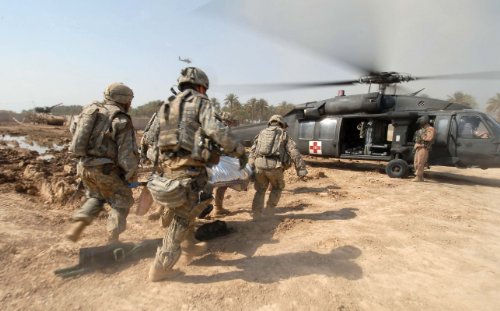
TCCC / TC3 : DAMAGE CONTROL RESUSCITATION, TRANSFER AND TRANSPORT OF CRITICAL CARE TRAUMA PATIENTS AND INITIAL MANAGEMENT OF WAR WOUNDS
📄 Viewing lite version
Full site ›
⌛ 🇬🇧 United Kingdom pricing being fetched…
Prices will appear once fetched — usually within a few minutes.
View in:
🇺🇸 USA
Book Details
Author(s)U.S. Army
PublisherU.S. Army
ISBN / ASINB00HORC3PC
ISBN-13978B00HORC3P9
MarketplaceUnited Kingdom 🇬🇧