In this collection of English translations of his Tamil short stories, Indira Parthasarathy stays true to form, portraying realistic slices of life with humour and sympathy. His characters, whether dying father, estranged son, autorickshaw driver, retired government servant or faithful wife are lifted from everyday milieus. In the usual, the author finds the unusual, prompting the reader to reflect on the extent to which our seemingly everyday experiences affect the tenor of our lives.
High Noon, a novella, was first published in Tamil in 1968 as Utchi Veyil. It was made into a film, Marupakkam, by Sethu Madhavan and won the Swarna Kamal Award 1990.
Apart from the novella, the book includes twelve of the author's short stories, perhaps, to represent the last five decades of his writing. ‘High Noon’ and ‘The Journey’ were written in the late sixties of the last century, ‘Worship’, ‘A Pleasant Evening’, ‘Far, Far Away’, and ‘Rotten Hordes’ in the seventies, ‘Justice’, in the eighties, ‘Spotty’, ‘A Feast for Equals’, ‘What Price Compassion?’, and ‘Susaiamma and Advaita’ in the nineties and ‘A Disciple’s Offering’ and ‘Asvattama’ in 2007.
From the author's preface.
I wrote Utchi Veyil in 1968, soon after my father’s death. Happening in Kumbakonam, my native town, this was my first long story based outside Delhi. The novella was published by Vacakar Vattam, an innovative publishing concern in the sixties that was, perhaps, ahead of its time. The story, when published along with five more novellas of up and coming writers like me, won critical acclaim as ‘a totally different piece of fiction portraying the distinctive cultural flavour of Tanjavur district.’ I thoroughly enjoyed writing this short novel, as it had some autobiographical references.
‘The Journey’, was written soon after my mother’s death in Delhi in 1969. Of course, I am not a ‘fingering slave’ ‘to peep’ and fictionalise ‘over my mother’s grave’, as Wordsworth would say, but I could not have helped an intrinsic part of me, detaching itself from my sorrowing self, to watch and observe others, who had arrived at the funeral to play the role, expected of them.
‘Worship’ is a period story happening in the 11th century. It poses a typically modern question, ‘What is chastity?’ According to the heroine and her husband in this story, it had nothing to do with sex. They were the disciples of Ramanuja, the philosopher-saint and also one of the pioneers of social reform in India. At the end of the story, Ramanuja accepted the one, who did apparently ‘sin’ but had the integrity and moral decency to regret, as one of his disciples.
I wrote ‘A Pleasant Evening’ to tease my wife. She had invited her former classmate and her husband, a stiff-collared, blue-blooded bureaucrat for dinner. In my story I made him a timber merchant. I found conversation between me and him was tough and heavygoing and, as the evening began to fade, the rest was silence!
The cruelty of living, the helpless suffering of a middle class man in an heartless metropolitan city like Delhi, finds its focus in the story, ‘Far, Far Away’. ‘Rotten Hordes’ portrays the initiation of political and social degradation in Tamil Nadu in the early seventies.
I wrote ‘Justice’, when I was in Warsaw, Poland. One of the Jewish professors in Warsaw university, committed suicide, protesting against the atrocities in Beirut at that time. The theme of the story is my visualisation.
--- Indira Parthasarathy
About the Author
Indira Parthasarathy is the nom de plume of Professor R Parthasarathy, a well known contemporary Indian Tamil writer. He has received several awards for his writing, including some of the highest honours in the fields of Indian literature and performing arts. The prestigious Sangeet Natak Akademi and Sahitya Akademi awards and Saraswati Samman are among these.
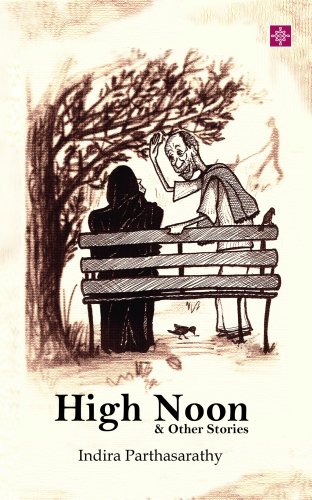
High Noon and Other Stories
📄 Viewing lite version
Full site ›
Price not listed
🛒 Buy New on Amazon 🇺🇸
Book Details
Author(s)Indira Parthasarathy
PublisherIndian Writing
ISBN / ASINB00IFD7PTS
ISBN-13978B00IFD7PT1
Sales Rank1,704,348
MarketplaceUnited States 🇺🇸