A monumental work.
The world s first book of its kind! Conceived and written for the use of universities professors, teachers of art history and history of ancient civilzations, as well as for students and researchers in the field. In this most unique book, the author explains the meaning, the message and structure of hundreds upon hundreds of Mesopotamian tablets, slabs, seals, obelisks, and cuneiform inscriptions.
It was said, A picture is worth a thousand words. True, very true! But what if a picture is hard to understand or does not explain what we are looking at?
This happens quite often in the vast literature and history of ancient civilizations. Especially, when the inscriptions on or under the pictures or illustrations are written in a language we do not understand, such as Cuneiform, Ugaritic, Akkadian, Sumerian, Phoenician, and similar writing systems of the ancient Middle and Near East.
In addition, there are thousands of slabs, cylinder seals, tablets, and obelisks of ancient and/or vanished civilizations, which are hard to decipher.
And in many instances, no pertaining inscriptions or texts were ever provided to explain what the statues, figurines, slabs and tablets represent.
To fully understand the scriptures, texts, epics and literature of Mesopotamia, Sumer, Assyria, Chaldea, Phoenicia, Ugarit, and the Anunnaki, one must become familiar with the meaning (Hidden or revealed) of the inscriptions, the symbolism camouflaged in intricate details, and the religious-artistic-philosophical nuances of the art of the era.
This requires authentic description, translation and explanation of:
Ancient symbols
Archeological finds
Maps
Seals and Slabs
Cuneiform inscriptions and writings
Statues and figurines
Carving/Illustrations/Drawings
Familiarity with historical sites, ruins, and cities
Linguistic analogies
And a perfect knowledge of the ancient languages and dialects of the ancient civilizations of the Near East, and the Middle East.
This book was written in order to deal with and to explain all these concerns, and above all to provide the readers with sufficient guidance, translation and explanation of major archeological finds, ranging from a figurine to a massive monument.
The book was written by an expert linguist, who authored several dictionaries of ancient and dead languages.
From the Content:
The goddess-angel Lama in a ritual gesture.
El Amarna Letters mentioning Abi-Milki.
Pharaoh Akhenaten.
Abkalu Apkallu as Winged Genii/Angels.
King Ashurnasirpal (On the left) being protected from demons and evil forces by Apkallu, his guardian spirit.
A Babylonian/Akkadian Abkalu guardian holding in his hand Lagi-zulum (Spathe of the Male Date-Palm).
Slab from the Northwest Palace of Ashur-nasirpal II at Nimrud, 883-859 B.C, showing the king and his guardian angel, the Apkallu.
Abzu Aps
Enki in the Abzu
Adamu Adapa , the sage.
Aguri (Burnt brick) of Busin, King of Ur, dedicated to god Ea.
Illustration of Anum (An, Anu) as chief of the Anunnaki.
Subjects bringing dates (Palm dates/fruits) to Anu.
Seal showing Dumuzi (Tammuz) being captured in the Sumerian Edin and bound by Ugalla the serpent-demon.
Ningishzida
Listing of gods in order of seniority.
Ea.
Scene from a Babylonian cylinder seal showing Ea Enki with two streams of water emerging from his shoulders, and the Sumerian sun-god Utu (Shamash in Akkadian, Shemesh in Phoenician).
Anunnaki god Ea accompanied by two deities in the form of a scorpion and a dragon.
Enki and Shamash. God Enki depicted with two streams of water erupting from his shoulders.
Ea riding the serpent-ship.
The serpent-ship from the Egyptian Book of the Dead .
Jewish subjects worshipping God Ea (Enki).
Priests of Ea.
Anzu
Scene from the Epic of Gilgamesh showing Enkidu on the left with a spear, and on the right Gilgamesh killing the bird-man Anzu, with a dagger.
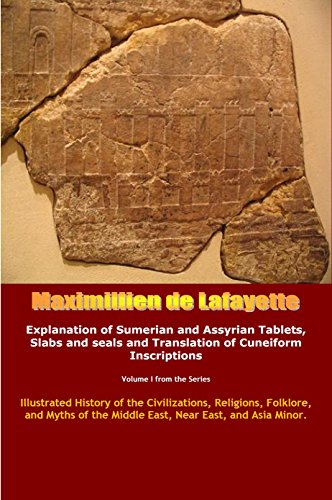
Vol.1. Explanation of Sumerian and Assyrian Tablets, Slabs and seals and Translation of Cuneiform Inscriptions (Illustrated History of the Civilizations, ... Middle East, Near East, and Asia Minor.)
📄 Viewing lite version
Full site ›
Price not listed
🛒 Buy New on Amazon 🇺🇸
Book Details
Author(s)Maximillien de Lafayette
ISBN / ASINB00MT8DHHY
ISBN-13978B00MT8DHH4
Sales Rank641,605
CategoryKindle Edition
MarketplaceUnited States 🇺🇸
Description ▲
More Books in Kindle Edition
Invisible Acts of Power: Channeling Grace in Your Ever…
View
Interzone #250 Jan - Feb 2014 (Science Fiction and Fan…
View
Down from the Clouds (The Unspoken Series Book 2)
View
Detox Your Spirit
View
Power Principles for Fearless & Abundant Living
View
The Isoquinoline Alkaloids: A Course in Organic Chemis…
View
Bow Down to the Wolf King [Royal Alphas 1] (Siren Publ…
View
Perfect Phrases for New Employee Orientation and Onboa…
View
Polar Bear S-express
View