ARTS: The Arts in Religious and Theological Studies (vol. 1, no. 1), 1988
📄 Viewing lite version
Full site ›
⌛ 🇫🇷 France pricing being fetched…
Prices will appear once fetched — usually within a few minutes.
View in:
🇺🇸 USA
Book Details
Author(s)Wilson Yates
PublisherUnited Theological Seminary
ISBN / ASINB014TS359G
ISBN-13978B014TS3594
MarketplaceFrance 🇫🇷
Description ▲
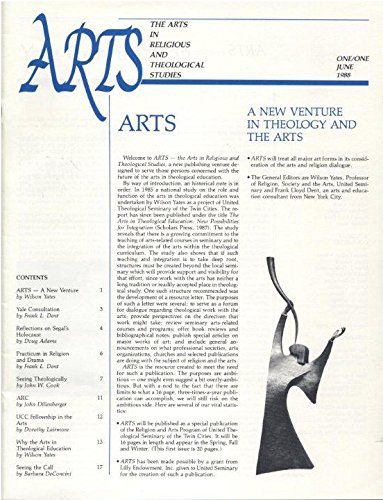
In the inaugural issue of ARTS, Wilson Yates begins with the words, Welcome to ARTS: the Arts in Religious and Theological Studies, a new publishing venture designed to serve those persons concerned with the future of the arts in theological education. In ARTS: A New Venture, he gives a historical backdrop to the origin of ARTS, and outlines its purposes, including the hope that ARTS would serve as a catalyst for furthering the dialogue between theology and the arts. Frank L. Dent reports that The Arts in Relation to the Nature and Content of Theological Education was the topic of a consultation of 19 theologians and administrators at Yale, in his piece, Yale Institute of Sacred Music Holds Consultation on the Arts and Theological Education. Doug Adams publishes a short essay, Reflections on Segal's The Holocaust, which includes three of Adams' own photographs of the Segal sculpture. Frank L. Dent profiles a practicum in religion and drama from Drew University's Theological School in his article, A Case Study: Practicum in Religion and Drama. John W. Cook writes of Theological Education and the Need to See Theologically, taken from his address to the Association of Theological School's meeting in San Francisco in June 1988. John Dillenberger reviews the formation in 1962 of The Society for the Arts Religion and Contemporary Culture (ARC). Wilson Yates contributes an article, Why the Arts?: Administrators on the Arts. And Barbara DeConcini rounds out the issue with an article, Seeing the Call, about work alternatively referred to as folk, visionary, naive, outsider, primitive, and vernacular. She writes that this work both embraces and challenges its own traditional protestant roots, and that this context of a visionary call also signals how this work is embedded in an artistic tradition.