As per the syllabus of Uttar Pradesh Technical University
This book is a sequel to the author’s Engineering Physics Part I and is written to address the course curriculum in Engineering Physics-II (Course Code EAS-102) of the B.Tech syllabus of the Uttar Pradesh Technical University. The book is designed to meet the needs of the first-year undergraduate students of all branches of engineering. It provides a sound understanding of the important phenomena in physics.
The book exposes the students to fundamental knowledge in areas of :
?Wave nature of matter, quantum theory of radiation, de Broglie matter waves, the Heisenberg uncertainty relations, Schrödinger wave equations, etc.
?Types of X-rays, diffraction of X-rays, X-ray spectrometer, Compton effect
?Dielectric properties of materials, Langevin’s theory, ferroelectricity and piezoelectricity, principle of microwave oven
?Ferromagnetic, ferrimagnetic, antiferromagnetic, diamagnetic and paramagnetic materials, phenomenon of hysteresis and its applications
?Generation, detection and application of ultrasonic waves
?Electromagnetic waves, Maxwell’s equations of electromagnetism, notion of displacement current, propagation characteristics of EM waves, energy in EM waves, etc.
?Superconductors, temperature dependence of their resistivity, effect of magnetic fields on superconductivity, BCS theory, and application of superconductors
?Nanomaterials, structures, properties and uses of carbon nanotubes, and several potential applications of nanoscience and nanotechnology.
KEY FEATURES
?Numerous solved examples in each chapter on the pattern of previous years’ question papers to stress conceptual understanding
?Chapter-end model questions to probe a student’s grasp of the subject matter
?Chapter-end numerical problems (with answers) to enhance the student’s problem solving skills
?Chapter-end objective type questions (with answers) for self-evaluation by the students
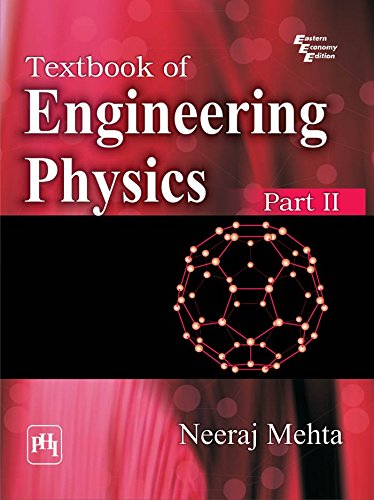
Textbook of Engineering Physics Part II
📄 Viewing lite version
Full site ›
⌛ 🇬🇧 United Kingdom pricing being fetched…
Prices will appear once fetched — usually within a few minutes.
View in:
🇺🇸 USA
Book Details
Author(s)Neeraj Mehta
PublisherPHI Learning
ISBN / ASINB01FHC5I52
ISBN-13978B01FHC5I59
MarketplaceUnited Kingdom 🇬🇧