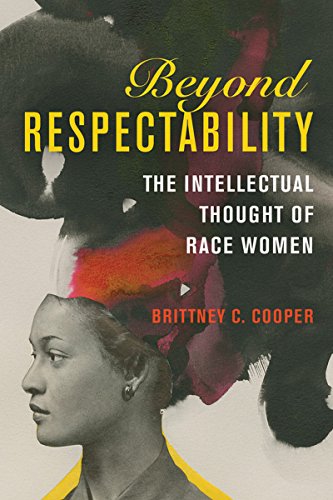
Beyond Respectability: The Intellectual Thought of Race Women (Women, Gender, and Sexuality in American History)
📄 Viewing lite version
Full site ›
Price not listed
🛒 Buy New on Amazon 🇺🇸
Book Details
Author(s)Brittney C. Cooper
PublisherUniversity of Illinois Press
ISBN / ASINB0717794JN
ISBN-13978B0717794J1
Sales Rank352,474
MarketplaceUnited States 🇺🇸
Description ▲
Beyond Respectability charts the development of African American women as public intellectuals and the evolution of their thought from the end of the 1800s through the Black Power era of the 1970s. Eschewing the Great Race Man paradigm so prominent in contemporary discourse, Brittney C. Cooper looks at the far-reaching intellectual achievements of female thinkers and activists like Anna Julia Cooper, Mary Church Terrell, Fannie Barrier Williams, Pauli Murray, and Toni Cade Bambara. Cooper delves into the processes that transformed these women and others into racial leadership figures, including long-overdue discussions of their theoretical output and personal experiences. As Cooper shows, their body of work critically reshaped our understandings of race and gender discourse. It also confronted entrenched ideas of how--and who--produced racial knowledge.
Similar Products ▼
- Eloquent Rage: A Black Feminist Discovers Her Superpower
- How We Get Free: Black Feminism and the Combahee River Collective
- The Crunk Feminist Collection
- Black Feminism Reimagined: After Intersectionality (Next Wave: New Directions in Women's Studies)
- Remaking Black Power: How Black Women Transformed an Era (Justice, Power, and Politics)
- Set the World on Fire: Black Nationalist Women and the Global Struggle for Freedom (Politics and Culture in Modern America)
- Words of Fire: An Anthology of African-AmericanFeminist Thought
- Black on Both Sides: A Racial History of Trans Identity
- Colored No More: Reinventing Black Womanhood in Washington, D.C. (Women, Gender, and Sexuality in American History)
- Gender and Jim Crow, Second Edition: Women and the Politics of White Supremacy in North Carolina, 1896-1920 (Gender and American Culture)