No reviews yet.
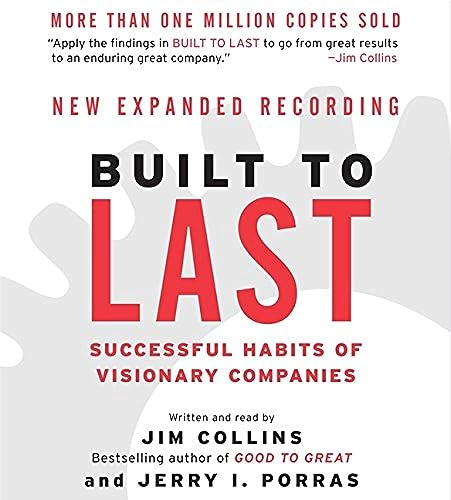
Built to Last identifies 18 "visionary" companies and sets out to determine what's special about them. To get on the list, a company had to be world famous, have a stellar brand image, and be at least 50 years old. We're talking about companies that even a layperson knows to be, well, different: the Disneys, the Wal-Marts, the Mercks.
Whatever the key to the success of these companies, the key to the success of this book is that the authors don't waste time comparing them to business failures. Instead, they use a control group of "successful-but-second-rank" companies to highlight what's special about their 18 "visionary" picks. Thus Disney is compared to Columbia Pictures, Ford to GM, Hewlett Packard to Texas Instruments, and so on.
The core myth, according to the authors, is that visionary companies must start with a great product and be pushed into the future by charismatic leaders. There are examples of that pattern, they admit: Johnson & Johnson, for one. But there are also just too many counterexamples--in fact, the majority of the "visionary" companies, including giants like 3M, Sony, and TI, don't fit the model. They were characterized by total lack of an initial business plan or key idea and by remarkably self-effacing leaders. Collins and Porras are much more impressed with something else they shared: an almost cult-like devotion to a "core ideology" or identity, and active indoctrination of employees into "ideologically commitment" to the company.
The comparison with the business "B"-team does tend to raise a significant methodological problem: which companies are to be counted as "visionary" in the first place? There's an air of circularity here, as if you achieve "visionary" status by ... achieving visionary status. So many roads lead to Rome that the book is less practical than it might appear. But that's exactly the point of an eloquent chapter on 3M. This wildly successful company had no master plan, little structure, and no prima donnas. Instead it had an atmosphere in which bright people were both keen to see the company succeed and unafraid to "try a lot of stuff and keep what works." --Richard Farr