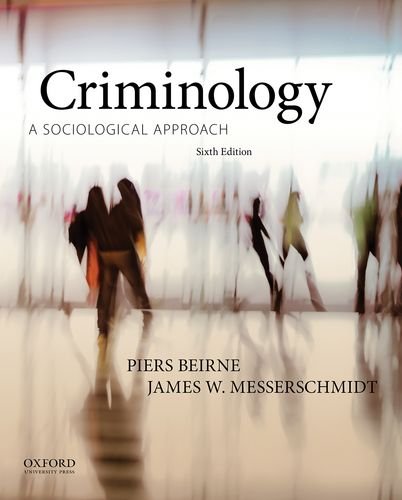
Ideal for undergraduate courses in criminology--especially those taught from a critical perspective--Criminology: A Sociological Approach, Sixth Edition, is a comprehensive yet highly accessible introduction to the study of crime and criminological theory. Authors Piers Beirne and James W. Messerschmidt present the topic from a sociological standpoint, emphasizing the social construction of crime and showing how crime relates to gender, class, race, and age. Providing students with a strong theoretical foundation, the book also addresses historical, feminist, and comparative perspectives and highlights the major types of crime and victimization patterns.
THE TEXT IS DIVIDED INTO THREE PARTS:
* Part I focuses on four questions: "What is crime?" "How are perceptions of it influenced by the mass media and by fear of
crime?" "How can we measure how much crime there is in the United States?" and finally, "How often does crime occur and with what degrees of seriousness?"
* Part II is a systematic guide to modern criminological theory and its historical development
* Part III examines specific types of crime, including property crime, interpersonal violence, white-collar crime, and political
crime, and it concludes with a chapter on comparative criminology and globalization
The sixth edition features new and up-to-date empirical data and also covers areas not included in many criminology texts, like cultural criminology, green criminology, whiteness and crime, the rape-war connection, Ponzi schemes, domestic right-wing terrorism, and state-sanctioned torture.