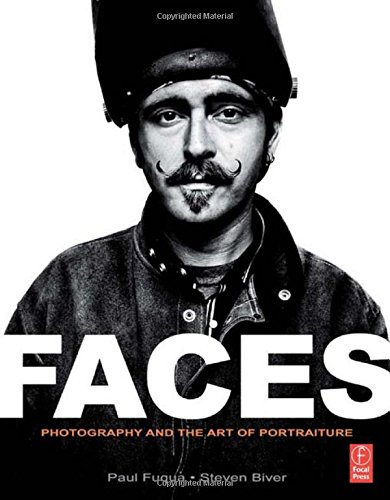


FACES: Photography and the Art of Portraiture
You can still browse on Amazon. Try another country above.
No reviews yet.
There is so much detail to be captured in a face. Cicero (106-43 BC) said: "The face is a picture of the mind as the eyes are its interpreter." To capture a person's personality, there are many things to keep in mind, and the authors of FACES show us how to match up a personality with lighting, posing, and composition. Portraiture is truly an art, and this book dives deep into the details so that you end up with a gorgeous portrait that both you and your subject love.
Not only is this book the most comprehensive title available on portraiture, but it contains stunning images. Each image is paired with a lighting diagram, a description of why the type of image was chosen, and then takes you through postproduction to put the finishing touches on. The authors also showcase a gallery of portraits by renowned photographers.
*Written by Paul Fuqua and Steven Biver, two of the authors of Light-Science and Magic
* Gallery of celebrity photographs by Nadav Kander, Joyce Tenneson, Sandro Miller, George Holz, Brent Stirton, and Dan Winters showcases both the studio and photojounalistic styles of portraiture
* Wide breadth of portraits--from street shots to studio shots, with a lighting diagram to accompany most of theseÂ
* The most gorgeous book for one of the most sought after photographic genres--people and portraits
Amazon Exclusive: An Essay and Tips to Taking Great Pictures by Pual Fuqua and Steven Biver, Authors of FACES: Photography and the Art of Portraiture
My Main Camera
Several years ago I came to the alarming realization that I was on the verge of becoming a certified, card-carrying member of the "Techno-Wonk photographers of America Society, Inc." Its members, God bless them, are easily recognized by the fact that they live and breathe numbers, specifications and the latest technical reports and equipment reviews. Well, that was me alright. My ability to ingest--and then happily regurgitate--camera, lens and flash tech sheets grew more noteworthy as each and every day went by. Trouble was, my pictures were growing progressively worse. Trouble was, my head was fully into photographic technology, not photography.
Obviously, radical action was called for, and fast. And that's why I became a minimalist shooter. Out from my kit went the big, heavy, fancy professional cameras and in came the "simple" ones--the "point and shoots" that I now use for most of my portrait making. Today I shoot the bulk of my pictures using two small pocket-fitting point-and-shoot cameras. One is from Canon, the other Nikon. The Cannon model that shoots RAW files is my main camera. The Nikon, because it does not shoot RAW, is my backup. Both of these amazing little jewels are miles removed from the sophisticated photographic "heavy artillery" to which I had become all too accustomed. But, be that as it may, both--now I am used to working with them--give me great images. But more importantly, largely because of their many limitations (such as super wide angle lenses, small zoom ranges, tiny flashes and the inability to open up really wide) these point-and-shoots have made me slow down and think out my picture making far more carefully than I did before. They've, to put it another way, pulled me back from being centered on picture-making technology, and pushed me forward to concentrate on the very basics of the act of picture making. And isn't that what photography is supposed to be about? Tips to Getting Great Pictures:
Tip #1--Lurking as a Life Style
You can spend lots of time mastering the many skills involved in street shooting. Figuring out your flash, learning what lens' do what and practicing proper camera handling will, for example, all can help you to bag better street shots. To me, however, mastering the fine art of lurking is more important. Dictionaries list plenty of definitions for the verb "to lurk." That's fine, but they don't connect well with making street portraits. So let me explain what "lurking" means to me. It's simple. Lurking means finding some place that's interesting to you and then doing as close to nothing as you can while quietly soaking up the scene up and making it a part of you. I, for example, enjoy working around such "people magnets" as markets, bus and train stations and cafes and carnivals. These locations draw people, and that's just what I want. When I find such a location, I look for someplace where I can sit down (hopefully in the shade, with a convenient coffee source and men's room nearby) and study what's going on around me and plan what I'm going to do with it. What's special about what I'm seeing? How can I best capture it? Where's the light coming from? What color is it? How about the shadows? Are the locals skittish, or does it look like they won't get too upset when I start asking to take their pictures? Are there places close by from where I can shoot from interesting angles? (Not long ago, for example, I climbed onto the roof of hay shed to get shots of camel herders in Egypt.) Are there nearby eating-places? They often yield great pictures. Sometimes it takes me hours to soak up a scene. On other occasions, a few minutes of lurking tells me what I need to know. It's then, and only then, that I start shooting.
Tip #2--Move In Close
No single thing guarantees a good portrait. There are, however, some things you can do that up the odds significantly. One of the simplest is to move in close to your subject. That does an obvious and very important thing for your photograph. It makes your subject's head relatively large in relation to the rest of the image. And that, in turn, makes it easy for your viewers to see, and study, your subject's face--in which they are usually most interested.
(Photo © Steven Biver)
Amazon Exclusive: Portraits from Steve Biver and Paul Fuqua
(Click to enlarge)
Charles-–An ambient light point-and-shoot street portrait taken in New OrleansDavid Gregory-– A celebrity, "one light on white" portrait Miss Prissy Pistol--A three lamp plus ambient light environmental portrait
