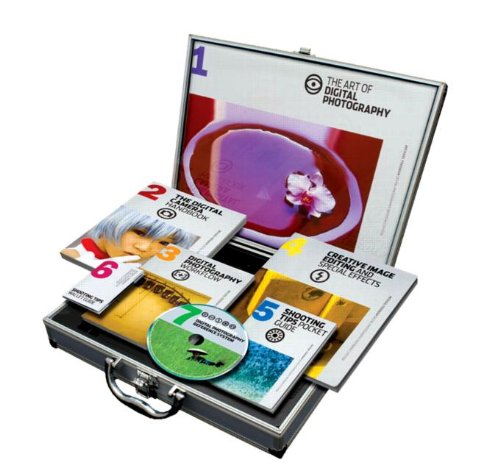


Michael Freeman's Digital Photography Reference System: The Complete Photographer's Library, in a Box
Selected Images from the Michael Freeman Digital Photography Reference System
Amazon Exclusive: A Letter from Michael Freeman on the Michael Freeman Digital Photography Reference System
Dear Amazon Readers,
And now for something completely different . . .
The way photography is moving in these digital days means that it’s much more than simply shoot and then hand the results over to a processing lab. There’s the digital workflow even as you’re out shooting, then the processing, captioning, archiving, and delivery. This is on top of the core photographic skills of managing the camera and equipment and . . . arguably the most important of all, how to see and compose strong, interesting images.
So we thought, let’s tailor a complete reference system so that each part is in exactly the perfect format, from a wallet-sized on-the-spot shooting guide to a DVD tutorial to a large-format book on composition, lighting and all the essential imaging techniques. Seven items in all, packed in a neat aluminum case. Here, though, I thought I’d chip in a little something extra: how the cover shot for the big book, The Art of Digital Photography, was shot. This isn’t actually in the book, so this is just for you Amazon readers.
What I’ve always liked about this image is its simplicity, color, and texture. It came about when I was shooting a book on contemporary Japanese design and interiors. This was a brand new house for a well-known theatre director, built on the coast of Okinawa, and it had a very special tea-ceremony room. This kind of room, uniquely Japanese, is incredibly formal, like the tea ceremony itself. But in this case the owner and architect wanted to do something different and break the rules. One rule is that the room has to have an alcove, and hanging in that alcove is a scroll painting or ink brush painting of scenery. What they did instead was make a long narrow window the same size as a painting, arranged so that it has a precise view of the side of a large rock, and the sea, which I thought was a very neat idea. The alcove should also have a small vase or pot with a single flower, but the design here was a massive red-lacquered slab with a circular depression carved and polished into it.
We poured a little water into this, and placed an orchid bloom to float in it. After I’d photographed the entire room (a tricky double-exposure problem, by the way), I went closer in. The way that the light from the narrow window caught the polished lacquer and the water surface was almost sensual, and certainly abstract, while the intricate and delicate texture of the orchid anchored the shot in reality. I used a 105mm Nikon macro lens--an old companion of mine--stopped it well down to between ƒ16 and ƒ22, and explored. In cases like this, where you know the effect of light and reflections will change with the tiniest shift in camera position, the thing to do is keep the camera to your eye and move around with it, looking only through the viewfinder.
I found three completely different (to me, anyway) images within inches of each other. Having discovered these by moving with the camera hand-held, I then put the tripod in position, because the small aperture and low ISO (pristine texture needed here in the smooth areas) meant a slow shutter speed. Precise framing was essential: two shots with perfect symmetry, one with a centered and exactly vertical line.
--Michael Freeman
Michael Freeman's Personal Top Ten Tips from the Michael Freeman Digital Photography Reference System
My personal ten top tips . . . ones that I actually follow myself.
You’ll find these and more in the kit, but I’ve made a special short selection . . .
- BCR: before going out to shoot, always check the three essentials that are easy to miss--Battery (you take it out to charge? Make sure you put it back)--memory Card (you take it out to download? Ditto!)--Raw (settings sometimes get changed, but shooting raw is essential because of what you can later pull out in processing).
- Choose one mode and stick to it: Cameras offer too big a choice of shooting mode. Make life simple for yourself by choosing the one that you’re most comfortable with--and don’t change to others. I use A for aperture, almost always.
- Know your shake rating: Know by practicing the slowest shutter speed at which you can guarantee to avoid camera shake. It varies with the lens focal length. Use the camera’s anti-shake feature if it has one.
- Think deep or shallow: Aperture controls not just exposure, but also depth of field. There are two ways to use it--selective focus on one detail from a wide aperture, or all-sharp from a small aperture. Decide what will best suit your subject before right from the start.
- Expose for what’s important: The most important exposure advice of all is to decide which subject in the frame is the most important, and expose for that. Only you can decide; the camera can’t tell you.
- Use the highlight clipping warning: The most valuable information on the back of your camera is the flashing warning that shows you’ve blown the highlights on the shot you just took. Heed it! Lower the exposure if necessary.
- Archive the light: If the subject doesn’t move (much), like a landscape or an interior, and if the lighting’s contrasty, shoot a range that varies the shutter speed by one or two stops. Reason: you’ve just archived the light, and can process it any way you like later.
- Don’t hesitate: All your camera settings are as they should be, right? If something’s happening in front of you, just shoot immediately. Hesitation or waiting will lose you that moment.
- (But) Work the subject: Your first shot may be the best, but you’ll never know if you don’t explore the subject. Stick around for a while, think about different camera angles, points of view, better moments.
- Composition interesting or boring?: Yes, composition’s a big subject and there’s no one-size-fits-all guaranteed formula, but at the very least experiment with the framing and your camera position. Try off-centering, try tilting, try anything that will make the composition a little more interesting. Keep reminding yourself of this.


