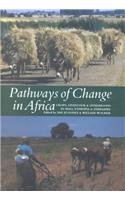


Pathways of Change in Africa: Crops, Livestock & Livelihoods in Mali, Ethiopia & Zimbabwe
No reviews yet.
Western experts on development and agriculture have frequently touted mixed farming, involving the integration of crops and livestock on a single farm, as an important means for increasing productivity and sustainability on small-scale African farms. Implicit in much of the literature on mixed farming is an evolutionary perspective that regards adoption of mixed farming methods as part of a linear progression towards an ideal agricultural condition. Scoones and Wolmer question this deterministic, evolutionary view. Through a series of case studies from Ethiopia, Zimbabwe, and Mali, the authors argue that African farmers themselves recognize that there are diverse pathways leading to agricultural change. In practice, African farmers and herders pursue a wider range of technology options than is assumed by development experts. Emphasis on mixed farming as the desired model for African farming misses other strategies and options vital to Africa's poor and marginalized farmers. Further, emphasis on the technological aspects of agricultural development misses many of the social and institutional processes by which Africans gain access to resources. Their book stresses the actual ways African farmers and herders practice agriculture and the social and institutional context in which Africans seek to pursue their interests.
