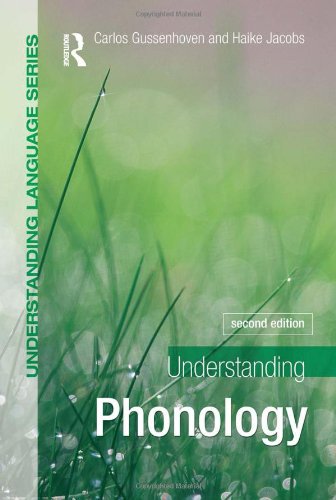


Understanding Phonology, 2nd Edition (Understanding Language Series)
Book Details
Author(s)
Carlos Gussenhoven, Haike Jacobs
Publisher
Hodder Education
ISBN / ASIN
0340807350
ISBN-13
9780340807354
Availability
Usually ships in 1 to 3 weeks
Sales Rank
#1,757,590
Marketplace
United States 🇺🇸
Ratings & Reviews
No reviews yet — be the first!
No reviews yet.
Description
The study of phonology is central to courses on language and linguistics. As one of the first volumes in the Understanding Language series, Understanding Phonology has proved to be a popular choice for students both in the UK and overseas.
In this new edition the authors have revised and updated the text in the light of recent research and also as a result of users' comments.
This skilfully written text provides a broad, yet up-to-date, introduction to phonology. Assuming no previous knowledge of phonology or linguistic theory, the authors introduce the basic concepts and build on these progressively, discussing the main theories and illustrating key points with carefully chosen examples. A wide range of phenomena are covered: speech production, segmental contrasts, tone, quantity, prosodic structure, metrical relations and intonation. The main theories, including feature geometry and optimality theory are introduced, and their contributions to our understanding of phonology, as well as their shortcomings, are discussed objectively.
Students will welcome the range of language from which the authors draw their examples and problems, and the originality of the presentations, discussions and examples.
Two corrections to this book should be noted:
Page 249, Q73, Answer 1: HL should read LH.
Page 263, Q123, Answer 2, Line 3: 'amuden' should read 'amumen'.
In this new edition the authors have revised and updated the text in the light of recent research and also as a result of users' comments.
This skilfully written text provides a broad, yet up-to-date, introduction to phonology. Assuming no previous knowledge of phonology or linguistic theory, the authors introduce the basic concepts and build on these progressively, discussing the main theories and illustrating key points with carefully chosen examples. A wide range of phenomena are covered: speech production, segmental contrasts, tone, quantity, prosodic structure, metrical relations and intonation. The main theories, including feature geometry and optimality theory are introduced, and their contributions to our understanding of phonology, as well as their shortcomings, are discussed objectively.
Students will welcome the range of language from which the authors draw their examples and problems, and the originality of the presentations, discussions and examples.
Two corrections to this book should be noted:
Page 249, Q73, Answer 1: HL should read LH.
Page 263, Q123, Answer 2, Line 3: 'amuden' should read 'amumen'.

