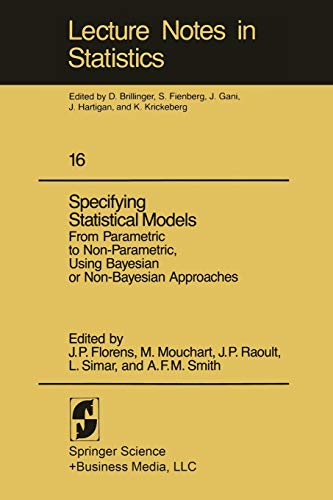


Specifying Statistical Models: From Parametric to Non-Parametric, Using Bayesian or Non-Bayesian Approaches (Lecture Notes in Statistics, 16)
Price not available for India
You can still browse on Amazon. Try another country above.
Book Details
Author(s)
Florens, J.P.
Publisher
Springer
ISBN / ASIN
0387908099
ISBN-13
9780387908090
Marketplace
India 🇮🇳
Ratings & Reviews
No reviews yet — be the first!
No reviews yet.
Description
During the last decades. the evolution of theoretical statistics has been marked by a considerable expansion of the number of mathematically and computationaly trac table models. Faced with this inflation. applied statisticians feel more and more un comfortable: they are often hesitant about their traditional (typically parametric) assumptions. such as normal and i. i. d . • ARMA forms for time-series. etc . • but are at the same time afraid of venturing into the jungle of less familiar models. The prob lem of the justification for taking up one model rather than another one is thus a crucial one. and can take different forms. (a) ~~~£ifi~~~iQ~ : Do observations suggest the use of a different model from the one initially proposed (e. g. one which takes account of outliers). or do they render plau sible a choice from among different proposed models (e. g. fixing or not the value of a certai n parameter) ? (b) tlQ~~L~~l!rQ1!iIMHQ~ : How is it possible to compute a "distance" between a given model and a less (or more) sophisticated one. and what is the technical meaning of such a "distance" ? (c) BQe~~~~~~ : To what extent do the qualities of a procedure. well adapted to a "small" model. deteriorate when this model is replaced by a more general one? This question can be considered not only. as usual. in a parametric framework (contamina tion) or in the extension from parametriC to non parametric models but also.
