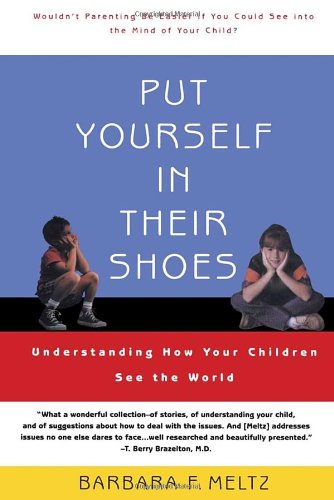


Put Yourself in Their Shoes: Understanding How Your Children See the World
Book Details
Author(s)
Barbara Meltz
Publisher
Dell
ISBN / ASIN
0440508231
ISBN-13
9780440508236
Availability
Usually ships in 24 hours
Sales Rank
#1,278,978
Marketplace
United States 🇺🇸
Description
Wouldn't parenting be easier if you could see into the mind of your child?
Learn to hear what your child can't or won't tell you--and
Understand Behavior
Build Values
Nurture Closeness
Solve Problems
In her popular Boston Globe column "Child Caring," Barbara Meltz has been writing about real-life parenting issues for more than a decade.  She has found that instead of divorce or moving--the situations parents think of as stressful--children's concerns are often linked to commonplace events such as sleepovers or the first day of school.
In this wise, compassionate book, Meltz offers parents a unique window into their child's inner life.  She includes candid, illuminating observations from kids themselves and offers advice on what to ask, listen for, or observe to decode puzzling behavior. . . how to get a child to talk about his or her problems. . . and how to find the best way to solve conflicts.  By focusing on developmental trouble spots, not age, her approach is as helpful to the parents of a two-year-old as to those of a twelve-year-old.  From keeping secrets to going to camp to larger issues, such as stealing or death in the family, Put Yourself in Their Shoes offers a way to see inside a child's world--and help to make it safe and strong.
Learn to hear what your child can't or won't tell you--and
Understand Behavior
Build Values
Nurture Closeness
Solve Problems
In her popular Boston Globe column "Child Caring," Barbara Meltz has been writing about real-life parenting issues for more than a decade.  She has found that instead of divorce or moving--the situations parents think of as stressful--children's concerns are often linked to commonplace events such as sleepovers or the first day of school.
In this wise, compassionate book, Meltz offers parents a unique window into their child's inner life.  She includes candid, illuminating observations from kids themselves and offers advice on what to ask, listen for, or observe to decode puzzling behavior. . . how to get a child to talk about his or her problems. . . and how to find the best way to solve conflicts.  By focusing on developmental trouble spots, not age, her approach is as helpful to the parents of a two-year-old as to those of a twelve-year-old.  From keeping secrets to going to camp to larger issues, such as stealing or death in the family, Put Yourself in Their Shoes offers a way to see inside a child's world--and help to make it safe and strong.
