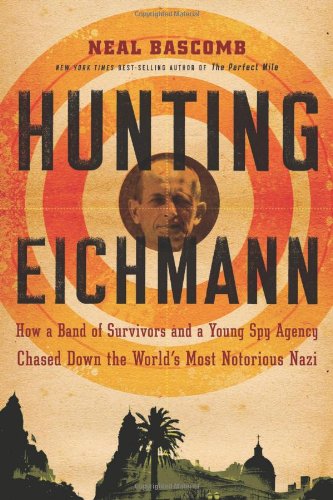


Hunting Eichmann: How a Band of Survivors and a Young Spy Agency Chased Down the World's Most Notorious Nazi
Price not available for France
You can still browse on Amazon. Try another country above.
Book Details
Author(s)
Neal Bascomb
Publisher
Houghton Mifflin Harcourt
ISBN / ASIN
0618858679
ISBN-13
9780618858675
Marketplace
France 🇫🇷
Ratings & Reviews
No reviews yet — be the first!
No reviews yet.
Description
Product Description
The first complete narrative of the pursuit and capture of Adolf Eichmann, based on groundbreaking new information and interviews and featuring rare, never-published Mossad surveillance photographs. When the Allies stormed Berlin in the last days of the Third Reich, the operational manager of the mass murder of Europe's Jews shed his SS uniform and vanished. Bringing Adolf Eichmann to justice would require a harrowing fifteen-year chase stretching from war-ravaged Europe to the shores of Argentina. Alternating from a criminal on the run to his pursuers closing in on his trail, Hunting Eichmann follows the Nazi as he escapes two American POW camps, hides in the mountains, slips out of Europe on the ratlines, and builds an anonymous life in Buenos Aires. Meanwhile, a persistent search for Eichmann gradually evolves into an international manhunt that includes a bulldog West German prosecutor, a blind Argentinean Jew and his beautiful daughter, and a budding, ragtag spy agency called the Mossad, whose operatives have their own scores to settle. Presented in a pulse-pounding, hour-by-hour account, the capture of Eichmann and the efforts by Israeli agents to secret him out of Argentina and fly him to Israel to stand trial bring the narrative to a stunning conclusion.Hunting Eichmann is a fully documented, finely nuanced history that offers the intrigue of a detective story and the thrill of great spy fiction.
The first complete narrative of the pursuit and capture of Adolf Eichmann, based on groundbreaking new information and interviews and featuring rare, never-published Mossad surveillance photographs. When the Allies stormed Berlin in the last days of the Third Reich, the operational manager of the mass murder of Europe's Jews shed his SS uniform and vanished. Bringing Adolf Eichmann to justice would require a harrowing fifteen-year chase stretching from war-ravaged Europe to the shores of Argentina. Alternating from a criminal on the run to his pursuers closing in on his trail, Hunting Eichmann follows the Nazi as he escapes two American POW camps, hides in the mountains, slips out of Europe on the ratlines, and builds an anonymous life in Buenos Aires. Meanwhile, a persistent search for Eichmann gradually evolves into an international manhunt that includes a bulldog West German prosecutor, a blind Argentinean Jew and his beautiful daughter, and a budding, ragtag spy agency called the Mossad, whose operatives have their own scores to settle. Presented in a pulse-pounding, hour-by-hour account, the capture of Eichmann and the efforts by Israeli agents to secret him out of Argentina and fly him to Israel to stand trial bring the narrative to a stunning conclusion.Hunting Eichmann is a fully documented, finely nuanced history that offers the intrigue of a detective story and the thrill of great spy fiction.
A Q&A with Neal Bascomb, Author of Hunting Eichmann
Q: What brought you to write Hunting Eichmann?
A: During my research, people asked me this countless times, and usually they prefaced it with the question of whether or not I was Jewish. When I answered the Jewish question in the negative, the overwhelming response was "Good, then you'll be seen as objective." About why I wrote the book: that answer is connected to the first one. You do not have to be Jewish to understand the incredible significance of the operation to catch Eichmann. Without it, our knowledge and perception of the Holocaust would be much more limited. Before the Eichmann trial, the Nazi atrocities were largely being swept under the rug, not spoken about. Only after the capture was there an extensive reexamination of the genocide; only then did it become rooted in our collective consciousness. In this respect, the operation is one of the most important, influential spy missions in history, period. Beyond a documentary over a decade ago, it has been almost fifty years since a journalist has taken a thorough look at what unfolded.Q: How did you find Eichmann's passport?A: Definitely one of the highlights of my research, because the document is tangible proof of how Eichmann escaped Europe. In late 2006, I was looking through old Buenos Aires newspapers when I came across a story about a lawsuit filed by Vera Eichmann against the Israelis. Court records are always one of my favorite places to research because they're often overlooked, but courts always keep meticulous records. Through one of my researchers, I petitioned the courts to see the lawsuit files. No response. I tried again. Come back in six weeks, they said, fill out this paperwork and that. Then again. You need a lawyer, they said. Then again. Finally we were given the records, which had never been accessed before. In the file was a long report about the Argentinean investigation into the capture, which was fascinating. But no passport! A few weeks later, we heard that the judge who approved our seeing the records had gone through the file before agreeing to its release and given the passport to the Holocaust museum in Buenos Aires. Fortunately, the judge credited my researcher with the discovery, and we were given full access to the passport.Q: What was the great challenge in writing the book?A: No debate. It was writing the narrative sections on Eichmann during the war, how he escaped, and how he lived while on the run. When I set out to write this history, I thought I would focus almost exclusively on the hunters, not the hunted. But after discovering a memoir by Eichmann on his postwar years, not to mention reading two well-known autobiographies, I really felt that I could accurately portray his actions and mindset. This got me into his head, so to speak--and this was an extremely uncomfortable place to be. For a while I had a bad case of insomnia, and when sleep did come, I had nightmares about his actions against the Jews. Although I knew I'd be affected by the subject matter, its level of intensity was surprising.Q: How active is the search for surviving Nazi war criminals today?A: A significant effect of the Eichmann case was the drive to bring the killers to justice, not only in the early 1960s, but half a century later. Before Eichmann, governments, including those of the United States, Germany, and even Israel, were doing very little. That was also the case with Simon Wiesenthal, who by 1960 had also largely given up his efforts. Today the Wiesenthal Center, led by its intrepid Nazi hunter Ephraim Zuroff, has launched a campaign to catch the last surviving Nazi war criminals. Beyond the Nazis, sadly, there are recent war criminals from conflicts in Darfur, the Balkans, and elsewhere. I believe that the drive to bring these individuals to account is, at least in part, a legacy of Eichmann, whose trial showed that perpetrators of genocide must pay for their crimes, and their acts must be made known to the world so that they can be prevented in the future.(Photo © Jillian Mcalley)


