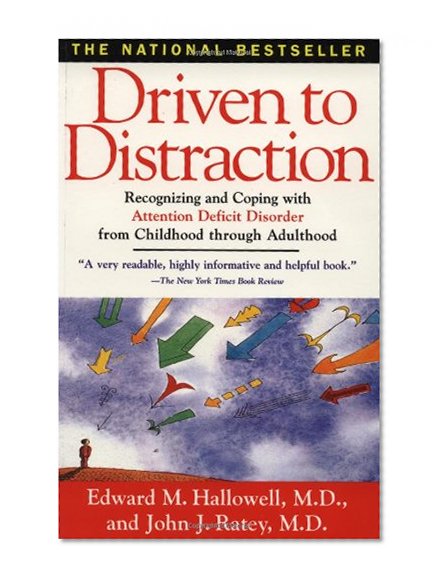


Driven to Distraction: Recognizing and Coping with Attention Deficit Disorder from Childhood Through Adulthood
16.00
USD
Book Details
Author(s)
Edward M. Hallowell, John J. Ratey
Publisher
Touchstone
ISBN / ASIN
0684801280
ISBN-13
9780684801285
Sales Rank
#60,594
Category
Psychology
Marketplace
United States 🇺🇸
Ratings & Reviews
No reviews yet — be the first!
No reviews yet.
Description
This clear and valuable book dispels a variety of myths about attention deficit disorder (ADD). Since both authors have ADD themselves, and both are successful medical professionals, perhaps there's no surprise that the two myths they attack most persistently are: (a) that ADD is an issue only for children; and (b) that ADD corresponds simply to limited intelligence or limited self-discipline. "The word disorder puts the syndrome entirely in the domain of pathology, where it should not entirely be. Although ADD can generate a host of problems, there are also advantages to having it, advantages that this book will stress, such as high energy, intuitiveness, creativity, and enthusiasm, and they are completely overlooked by the 'disorder' model." The authors go on to cite Mozart and Einstein as examples of probable ADD sufferers. (The problem as they see it is not so much attention deficit but attention inconsistency: "Most of us with ADD can in fact hyperfocus at times.") Although they warn against overdiagnosis, they also do a convincing job of answering the criticism that "everybody, and therefore nobody" has ADD. Using numerous case studies and a discussion of the way ADD intersects with other conditions (e.g., depression, substance abuse, and obsessive-compulsive disorder), they paint a concrete picture of the syndrome's realities. Especially helpful are the lists of tips for dealing with ADD in a child, a partner, or a family member. --Richard Farr




![Driven to Distraction: Recognizing and Coping with Attention Deficit Disorder from Childhood Through Adulthood Abridged on 2 CDs [Driven to Distraction]](https://www.ebooknetworking.net/books/B00/2NL/medB002NLHV6K.jpg)
![Driven To Distraction : Recognizing and Coping with Attention Deficit Disorder from Childhood Through Adulthood [Paperback]](https://www.ebooknetworking.net/books/B00/95H/medB0095HE62C.jpg)