Prices are the last we recorded for each Amazon store and change often. Open a market to see its current price.
No reviews yet.
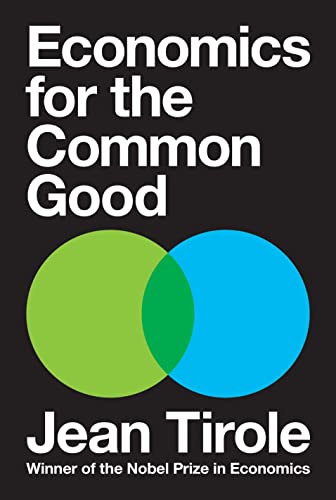
From Nobel Prize–winning economist Jean Tirole, a bold new agenda for the role of economics in society
When Jean Tirole won the 2014 Nobel Prize in Economics, he suddenly found himself being stopped in the street by complete strangers and asked to comment on issues of the day, no matter how distant from his own areas of research. His transformation from academic economist to public intellectual prompted him to reflect further on the role economists and their discipline play in society. The result is Economics for the Common Good, a passionate manifesto for a world in which economics, far from being a "dismal science," is a positive force for the common good.
Economists are rewarded for writing technical papers in scholarly journals, not joining in public debates. But Tirole says we urgently need economists to engage with the many challenges facing society, helping to identify our key objectives and the tools needed to meet them.
To show how economics can help us realize the common good, Tirole shares his insights on a broad array of questions affecting our everyday lives and the future of our society, including global warming, unemployment, the post-2008 global financial order, the euro crisis, the digital revolution, innovation, and the proper balance between the free market and regulation.
Providing a rich account of how economics can benefit everyone, Economics for the Common Good sets a new agenda for the role of economics in society.
 Radical Markets: Uprooting Capitalism and Democracy for a J…
 Capitalism without Capital: The Rise of the Intangible Econ…
 Adaptive Markets: Financial Evolution at the Speed of Thoug…
 Doughnut Economics: Seven Ways to Think Like a 21st-Century…
 The Curse of Bigness: Antitrust in the New Gilded Age
 People, Power, and Profits: Progressive Capitalism for an A…
 Straight Talk on Trade: Ideas for a Sane World Economy
 Mostly Harmless Econometrics: An Empiricist's Companion
 The Book of Why: The New Science of Cause and Effect
 The Price of Inequality: How Today's Divided Society E…