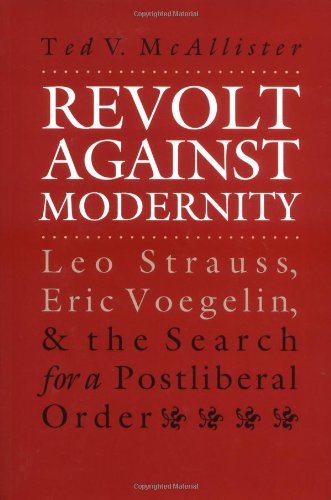


Revolt Against Modernity: Leo Strauss, Eric Voegelin, and the Search for a Postliberal Order
Book Details
Author(s)Ted V. McAllister, Ted V. McAllister
PublisherUniversity Press of Kansas
ISBN / ASIN0700608737
ISBN-139780700608737
AvailabilityUsually ships in 24 hours
Sales Rank1,335,754
MarketplaceUnited States 🇺🇸
Description
Eric Voegelin and Leo Strauss are two of the most provocative and durable political philosophers of this century. Ted McAllister's superbly written study provides the first comprehensive comparison of their thought and its profound influence on contemporary American conservatism.
Since the appearance in the 1950s of Strauss's Natural Right and History and Voegelin's Order and History, conservatives like Russell Kirk, Irving Kristol, and Allan Bloom have increasingly turned to these thinkers to support their attacks on liberalism and the modernist mindset.
Like so many conservatives, Strauss and Voegelin rebelled against modernity' amorality personified by Machiavelli, Hobbes, Rousseau, Kant, Hegel, and Nietzsche and its promotion of individualism and materialism over communal and spiritual responsibility. While both disdained the reductionist "conservative" label, conservatives nevertheless appropriated their philosophy, in part because it restored theology and classical tradition to the moral core of civil society.
For both men, modernity's debilitating disorder revealed surprising and disturbing relations among liberal, communist, and Nazi ideologies. In their eyes, modernity's insidious virus, so apparent in the Nazi and communist regimes, lies incubating within liberal democracy itself.
McAllister's thorough reevaluation of Strauss and Voegelin expands our understanding of their thought and restores balance to a literature that has been dominated by political theorists and disciples of Strauss and Voegelin. Neither reverential nor dismissive, he reveals the social, historical, political, and philosophical foundations of their work and effectively decodes their frequently opaque or esoteric thinking.
Well written and persuasively argued, McAllister's study will appeal to anyone engaged in the volatile debates over liberalism's demise and conservatism's rise.
Since the appearance in the 1950s of Strauss's Natural Right and History and Voegelin's Order and History, conservatives like Russell Kirk, Irving Kristol, and Allan Bloom have increasingly turned to these thinkers to support their attacks on liberalism and the modernist mindset.
Like so many conservatives, Strauss and Voegelin rebelled against modernity' amorality personified by Machiavelli, Hobbes, Rousseau, Kant, Hegel, and Nietzsche and its promotion of individualism and materialism over communal and spiritual responsibility. While both disdained the reductionist "conservative" label, conservatives nevertheless appropriated their philosophy, in part because it restored theology and classical tradition to the moral core of civil society.
For both men, modernity's debilitating disorder revealed surprising and disturbing relations among liberal, communist, and Nazi ideologies. In their eyes, modernity's insidious virus, so apparent in the Nazi and communist regimes, lies incubating within liberal democracy itself.
McAllister's thorough reevaluation of Strauss and Voegelin expands our understanding of their thought and restores balance to a literature that has been dominated by political theorists and disciples of Strauss and Voegelin. Neither reverential nor dismissive, he reveals the social, historical, political, and philosophical foundations of their work and effectively decodes their frequently opaque or esoteric thinking.
Well written and persuasively argued, McAllister's study will appeal to anyone engaged in the volatile debates over liberalism's demise and conservatism's rise.
