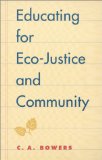
Educating for an Ecologically Sustainable Culture: Rethinking Moral Education, Creativity, Intelligence, and Other Modern Orthodoxies (Suny Series, ... (SUNY series in Environmental Public Policy)
26.21
USD
Book Details
Author(s)
C. A. Bowers,
Publisher
State University of New York Press
ISBN / ASIN
0791424987
ISBN-13
9780791424988
Sales Rank
#3,114,923
Marketplace
United States 🇺🇸
Ratings & Reviews
No reviews yet — be the first!
No reviews yet.
Description
Exposes the faulty assumptions that underlie modern education in the areas of moral education, creativity, and intelligence, showing how these assumptions must be changed in order to produce an ecologically sustainable culture.
“I am very enthusiastic about this book. The author has continued the high level of inquiry established in his Education, Cultural Myths, and the Ecological Crisis. The discussion of creativity, technology, and intelligence are superb. He is asking fundamental questions and doing so with real intellectual rigor and passion.†— David W. Orr, Oberlin College
This book is a wake-up call for environmentalists who need to consider how current educational ideals and practices undermine efforts to create a more sustainable future. It is also a wake-up call for educators who continue to base their reform efforts on the primacy of the individual, while ignoring the fact that the individual is nested in culture, and culture is nested in (and thus dependent upon) natural ecosystems. Bowers argues that the modern way of understanding moral education, creativity, intelligence, and the role of direct experience in the learning process cannot be supported by evidence from such fields as anthropology, cultural linguistics, and the sociology of knowledge.
“This is one of the best books I've read on the challenge of the environmental crisis to our forum of education and our deeply held assumptions as a culture. It is of urgent importance in itself and to several fields of study.†— Alan Drengson, University of Victoria
“Bowers shows how we cannot have an ecologically sustainable culture when our educational institutions continue to reinforce the very aspects of modern culture that are now devastating the environment. Modern culture is based on the idea that change is progressive and that the individual is the basic social unit. But Bowers explains that 'our own culture's highest values may now be the chief impediment to the evolution of a land ethic.' †— Dolores LaChapelle, author of Earth Wisdom and Sacred Land Sacred Sex
“I am very enthusiastic about this book. The author has continued the high level of inquiry established in his Education, Cultural Myths, and the Ecological Crisis. The discussion of creativity, technology, and intelligence are superb. He is asking fundamental questions and doing so with real intellectual rigor and passion.†— David W. Orr, Oberlin College
This book is a wake-up call for environmentalists who need to consider how current educational ideals and practices undermine efforts to create a more sustainable future. It is also a wake-up call for educators who continue to base their reform efforts on the primacy of the individual, while ignoring the fact that the individual is nested in culture, and culture is nested in (and thus dependent upon) natural ecosystems. Bowers argues that the modern way of understanding moral education, creativity, intelligence, and the role of direct experience in the learning process cannot be supported by evidence from such fields as anthropology, cultural linguistics, and the sociology of knowledge.
“This is one of the best books I've read on the challenge of the environmental crisis to our forum of education and our deeply held assumptions as a culture. It is of urgent importance in itself and to several fields of study.†— Alan Drengson, University of Victoria
“Bowers shows how we cannot have an ecologically sustainable culture when our educational institutions continue to reinforce the very aspects of modern culture that are now devastating the environment. Modern culture is based on the idea that change is progressive and that the individual is the basic social unit. But Bowers explains that 'our own culture's highest values may now be the chief impediment to the evolution of a land ethic.' †— Dolores LaChapelle, author of Earth Wisdom and Sacred Land Sacred Sex