Buy on Amazon
https://www.ebooknetworking.net/books_detail-0791429326.html
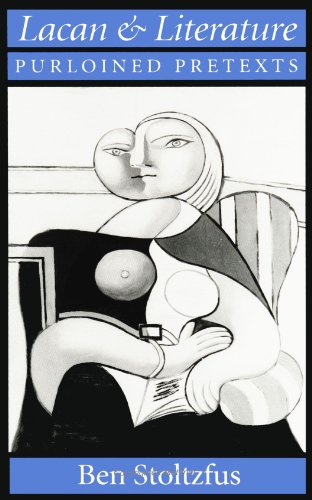
Lacan and Literature: Purloined Pretexts (SUNY series in Psychoanalysis and Culture)
Book Details
Author(s)Ben Stoltzfus
PublisherSUNY Press
ISBN / ASIN0791429326
ISBN-139780791429327
AvailabilityUsually ships in 1-2 business days
Sales Rank4,370,371
CategoryLiterary Criticism
MarketplaceUnited States 🇺🇸
Description
This book of literary criticsm uses Lacanian psychoanalytic theory to explicate Roland Barthes, Albert Camus, Ernest Hemingway, D.H. Lawrence, and Alain Robbe-Grillet.
Using Lacanian psychoanalytic theory in order to uncover the relationship between literature, reading, and the unconscious, this book argues for a special affinity between a text and its reader. This process strives to unveil the disguises of tropic language in order to generate manifest meaning from latent content. Focusing on five twentieth-century writers: D.H. Lawrence, Ernest Hemingway, Albert Camus, Roland Barthes, and Alain Robbe-Grillet, this book shows how Freud’s theories of condensation and displacement in dreams match Lacan’s uses of metaphor and metonymy in language. Despite the different backgrounds of these authors from America, England, and France, the unifying theme is that the unconscious (because it is structured like language) is the voice of the (m)Other disguised in figurative language.



