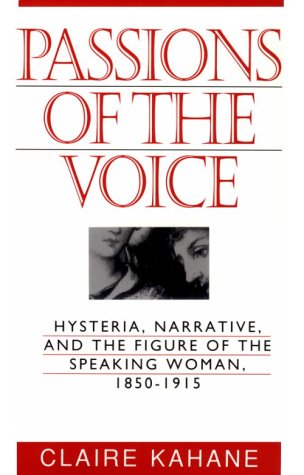


Passions of the Voice: Hysteria, Narrative and the Figure of the Speaking Woman, 1850-1915
In Passions of the Voice Claire Kahane argues that the subversion of gender definitions promoted especially by feminism in the late nineteenth century profoundly unsettled Victorian narrative discourse. Exploiting the psychoanalytic theory of hysteria, Kahane moves through a number of texts that manifest an anxiety of imagination provoked by the figure of the speaking woman, both as narrative trope and as historical agent. The result is a body of fiction in which the narrative voice not only loses control of the story it is tells but also ushers in modernist narrative poetics.
Kahane begins with a reading of Freud's "Dora: Fragment of an Analysis of a Case of Hysteria," a text in which Freud develops the concepts of hysterical narrative and of transference--and acts his own hysteria in his discourse as he constructs the meanings of Dora's. Subsequent chapters explore the hysterical voice in Florence Nightingale's Cassandra, Charlotte Bronte's Shirley, Alice James's Diary, Olive Schreiner's Story of an African Farm, Henry James's The Bostonians, Virginia Woolf's The Voyage Out, T. S. Eliot's "Hysteria," Joseph Conrad's Heart of Darkness, and Ford Madox Ford's The Good Soldier. Kahane delineates in each of these texts the features of a discourse in crisis around the breakdown of sexual difference. She concludes, however, that for modernist writers such as Woolf, Conrad, and Ford, hysteria was not a psychopathology subject to cure but a sign of the time.
"Offering, as Claire Kahane says, a kind of 'psycho-poetics of hysteria,' Passions of the Voice combines a brilliant command of psychoanalytic theory with a subtle understanding of literary texts to make innovative arguments that will be of intense interest to feminists, students of the Victorian and Modern periods, people interested in narrative theory and in psychoanalysis. An additional strength of the book is the way it provocatively crosses national and literary period boundaries -- showing modernism, for example, as a development within the late nineteenth century, not as a radical repudiation of it." -- James E. B. Breslin, University of California, Berkeley
