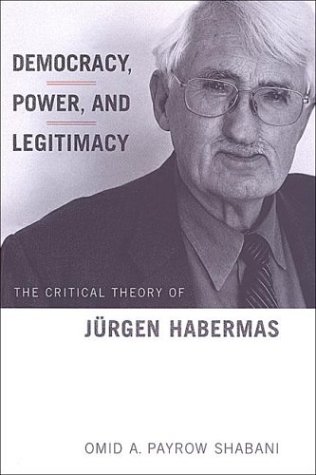


Democracy, Power, and Legitimacy: The Critical Theory of Jürgen Habermas
No reviews yet.
Over his long and fruitful scholarly life, Jürgen Habermas has patiently laboured to diagnose the limitations and free the potential of the project of modernity - the pursuit of the ideal of free society by rational subjects. Omid A. Payrow Shabani here analyses the development of Habermas's critical philosophy in its pursuit of a theory of justice that can address the ethico-political concerns of our diverse, pluralist, and fragmented society. He contends that Habermas's more recent work represents a position that is inadequately critical of the existing political order in liberal democracies.
Payrow Shabani situates Habermas's current philosophical orientation by laying out its historical background and theoretical sources in the work of Kant and Hegel, and charting its movement towards an account of communicative rationality. Habermas's discourse ethics in turn translates his theory of communication into a sociological critique of democracy in advanced capitalism. Yet, Payrow Shabani argues, in his impressive effort to theorize deliberative democracy, and the role of law and power therein, Habermas concedes too much to 'real-existing' capitalism, and thus legitimizes political power as currently exercised in Western democracies.
The deficiencies of Habermas's theory can be overcome, Payrow Shabani proposes, by appropriating Foucault's analysis of power as a contestational network of relations flowing in all directions. Similarly, he argues, incorporating Derrida's deconstructive strategy allows for a distinction between the presence of law and the attainment of justice, which is always to come, Ã -venir. In this view, contestation and dissent are seen as critical democratic values. For Payrow Shabani, such a refurbished critical theory recognizes the diversity of public deliberation in modern democracies, where the pursuit of the ideal of justice is an enduring negotiation that is never completed.
