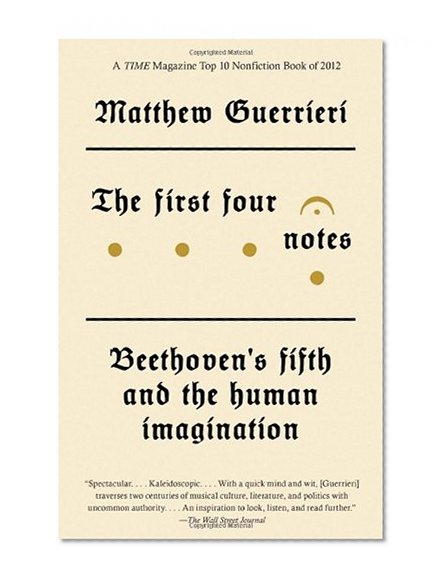


The First Four Notes: Beethoven's Fifth and the Human Imagination
You can still browse on Amazon. Try another country above.
No reviews yet.
Essay by Author, Matthew Guerrieri
In his bestseller Beethoven: the Man who Freed Music, first published in 1929, the poet and essayist Robert Haven Schauffler polled a parade of opinions of Beethoven s Fifth from a pool of straw men: To Brown it may signify a fierce conflict with a sexual obsession. To Jones a desperate campaign against an inferiority complex. To Robinson an old-fashioned pitched battle la Paradise Lost, between the forces of good and evil. To a victim of hysteria it may depict a war between sanity and bedlam. To a neurasthenic a struggle between those two mutually exclusive objectives: To be, or not to be? To an evolutionist it may bring up the primordial conflict of fire and water, of man with beast, of civilization with savagery, of land with sea.
Such mutable celebrity has perpetually surrounded the symphony. Beethoven s Fifth, the Symphony in C minor, opus 67, might not be the greatest piece of music ever written even Beethoven himself preferred his Third Symphony, the Eroica but it must be the greatest great piece ever written, a figure on which successive mantles of greatness have, ever more inevitably, fit with tailored precision. And its iconic opening is a large part of that: short enough to remember and portentous enough to be memorable, seeming to unlock the symphony s meaning but leaving its mysteries temptingly out of reach, saying something but admitting nothing.
The First Four Notes is a book about Beethoven s Fifth Symphony. More specifically, it is a book about the opening notes of that symphony; and more specifically than that, it is a book about what people have heard in those notes throughout history, and how history itself has affected what was heard. It is, then, history viewed through the forced perspective of one piece of music (though, to be fair, there is only a handful of pieces of music that could yield a comparable view, and most of them are by Beethoven).
To say a piece of music has meaning is to say that it is susceptible to discussions of meaning; by that standard, Beethoven s Fifth is easily one of the most meaningful pieces of music ever written. The number and variety of the interpretations assigned to the Fifth, the creativity with which the piece has been invoked in support of countless, often contradictory causes artistic, philosophical, political is a tribute to its amorphous power. It is also, on the side of the interpreters, a testament to human creativity, ingenuity and folly. The vaunted universality of Beethoven s achievement encompasses the sublime and the ridiculous.
Not that he didn t try to warn us. In 1855, an unknown writer felt compelled to make a handwritten addition to a copy of Anton Schindler s biography of Beethoven: Something about the beginning of the C minor Symph[ony]. Many men were disturbed over the beginning of the Fifth. One of them ask[ed] Beethoven about the reason for the unusual opening and its meaning. Beethoven answered: The beginning sounds and means: You are too dumb.
Matthew Guerrieri (adapted from the prologue to The First Four Notes)


