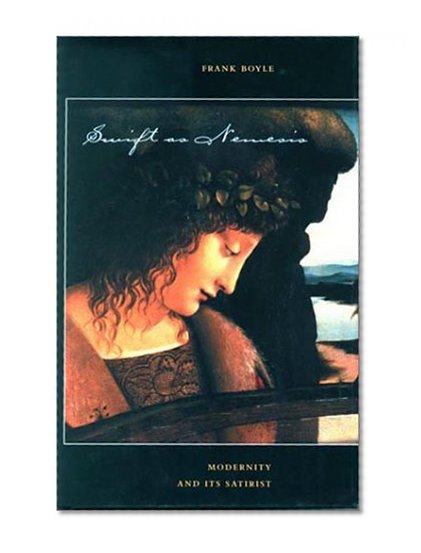


Swift as Nemesis: Modernity and Its Satirist
Book Details
Author(s)
Frank Boyle
Publisher
Stanford University Press
ISBN / ASIN
0804734364
ISBN-13
9780804734363
Availability
Usually ships in 24 hours
Sales Rank
#5,458,227
Marketplace
United States 🇺🇸
Description
With much of the intellectual discourse of the last several decades concerned with reconsiderations of modernity, how do we read the works of Jonathan Swift, who ridiculed the modern even as it was taking shape? The author approaches the question of modernity in Swift by way of a theory of satire from Aristotle via Swift (and Bakhtin) that eschews modern notions that satire is meant to reform and correct. Linking satire to Nemesis, the goddess of righteous vengeance, Swift as Nemesis develops new readings of Swift's major satires.
From his first published work, Swift associates the modern with the new science and represents modernity as a pernicious strain of narcissism that devalues humanistic discourse. In his early satires, he compiles a profane history of the modern in which the new philosophy is an extension of the methodology of alchemists, the debased Roman Catholic Church, and the various Puritan sects. This history culminates in A Tale of a Tub with an assault on the intellectual basis of that most formidable of all modern works, Newton's Principia.
In Gulliver's Travels, Swift attacks modern culture while aiming at individual readers. Novelistic identification with Gulliver's narcissism (beginning with masturbation and encompassing various scatological observations) implicates readers in the larger cultural critique in which Gulliver, paralleling Narcissus, rejects cultures he encounters until he embraces a cultural image that destroys him. The wider cultural implications of Swift's work are evident in the way he uses travel as a metaphor to link the inhuman consequences of European imperialism with the discoveries of the new science.
Finally, Swift's works, like the mirror Nemesis uses to destroy Narcissus, are shown to return the narcissistic projections of critics. Recognizing that Narcissus and Echo have become important to the critique of modernism, the author argues that readers will find it useful now to turn to the contextualizing role of Nemesis. She emerges from Swift's critically irreducible satire with an ironic claim on modernity itself.
From his first published work, Swift associates the modern with the new science and represents modernity as a pernicious strain of narcissism that devalues humanistic discourse. In his early satires, he compiles a profane history of the modern in which the new philosophy is an extension of the methodology of alchemists, the debased Roman Catholic Church, and the various Puritan sects. This history culminates in A Tale of a Tub with an assault on the intellectual basis of that most formidable of all modern works, Newton's Principia.
In Gulliver's Travels, Swift attacks modern culture while aiming at individual readers. Novelistic identification with Gulliver's narcissism (beginning with masturbation and encompassing various scatological observations) implicates readers in the larger cultural critique in which Gulliver, paralleling Narcissus, rejects cultures he encounters until he embraces a cultural image that destroys him. The wider cultural implications of Swift's work are evident in the way he uses travel as a metaphor to link the inhuman consequences of European imperialism with the discoveries of the new science.
Finally, Swift's works, like the mirror Nemesis uses to destroy Narcissus, are shown to return the narcissistic projections of critics. Recognizing that Narcissus and Echo have become important to the critique of modernism, the author argues that readers will find it useful now to turn to the contextualizing role of Nemesis. She emerges from Swift's critically irreducible satire with an ironic claim on modernity itself.
