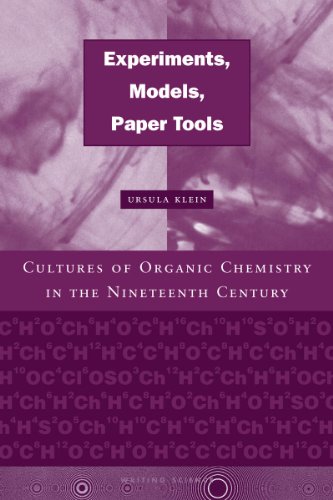


Experiments, Models, Paper Tools: Cultures of Organic Chemistry in the Nineteenth Century (Writing Science)
Book Details
Author(s)
Ursula Klein
Publisher
Stanford University Press
ISBN / ASIN
0804743592
ISBN-13
9780804743594
Availability
Usually ships in 24 hours
Sales Rank
#532,135
Marketplace
United States 🇺🇸
Ratings & Reviews
No reviews yet — be the first!
No reviews yet.
Description
In the early nineteenth century, chemistry emerged in Europe as a truly experimental discipline. What set this process in motion, and how did it evolve? Experimentalization in chemistry was driven by a seemingly innocuous tool: the sign system of chemical formulas invented by the Swedish chemist Jacob Berzelius. By tracing the history of this “paper tool,†the author reveals how chemistry quickly lost its orientation to natural history and became a major productive force in industrial society.
These formulas were not merely a convenient shorthand, but productive tools for creating order amid the chaos of early nineteenth-century organic chemistry. With these formulas, chemists could create a multifaceted world on paper, which they then correlated with experiments and the traces produced in test tubes and flasks.
The author’s semiotic approach to the formulas allows her to show in detail how their particular semantic and representational qualities made them especially useful as paper tools for productive application.
These formulas were not merely a convenient shorthand, but productive tools for creating order amid the chaos of early nineteenth-century organic chemistry. With these formulas, chemists could create a multifaceted world on paper, which they then correlated with experiments and the traces produced in test tubes and flasks.
The author’s semiotic approach to the formulas allows her to show in detail how their particular semantic and representational qualities made them especially useful as paper tools for productive application.
