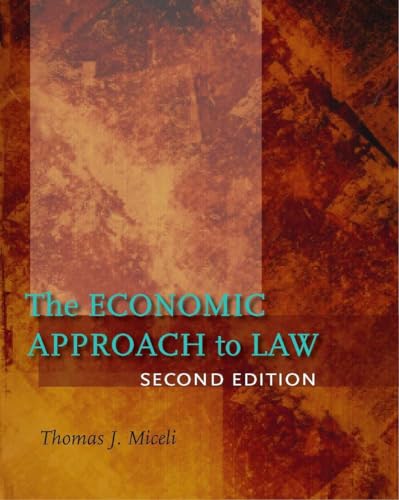


The Economic Approach to Law, Second Edition
Book Details
Author(s)
Thomas Miceli
Publisher
Stanford Economics and Finance
ISBN / ASIN
0804756708
ISBN-13
9780804756709
Availability
Usually ships in 24 hours
Sales Rank
#310,939
Category
Hardcover
Marketplace
United States 🇺🇸
Description
Designed specifically for economics students, The Economic Approach to Law, 2nd Edition, provides an introductory treatment of law and economics, revealing how economic principles explain the structure of the law, and how they can help make the law more efficient. To that end, the author focuses on unifying themes in the field—rather than exhaustively covering legal topics—and thus provides a more analytical treatment of the subject.
The second edition includes current research into the economics of common law areas, such as torts, contracts, and property law. The revised text also offers a new chapter that explores how economics can be applied to anti-trust law, as well as added material on intellectual property. This edition features an expanded suite of exercises and problems at the end of each chapter to encourage students to "do" law and economics.
A companion web site offers a full suite of resources for students and professors. Key pedagogical features include cases; discussion points that provide additional analysis of topics in the book; graduate notes, which deepen the text for more advanced readers; and relevant Web links. Professors have access to sample syllabi for undergraduate and graduate courses and to an instructor's manual providing suggested answers to all of the end-of-chapter questions/problems in the book.
The second edition includes current research into the economics of common law areas, such as torts, contracts, and property law. The revised text also offers a new chapter that explores how economics can be applied to anti-trust law, as well as added material on intellectual property. This edition features an expanded suite of exercises and problems at the end of each chapter to encourage students to "do" law and economics.
A companion web site offers a full suite of resources for students and professors. Key pedagogical features include cases; discussion points that provide additional analysis of topics in the book; graduate notes, which deepen the text for more advanced readers; and relevant Web links. Professors have access to sample syllabi for undergraduate and graduate courses and to an instructor's manual providing suggested answers to all of the end-of-chapter questions/problems in the book.


