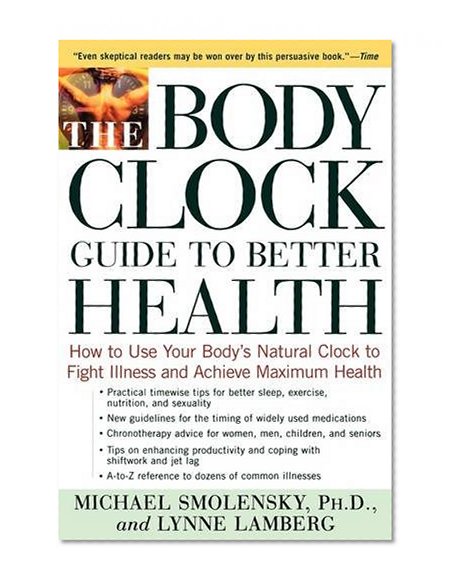


The Body Clock Guide to Better Health: How to Use your Body's Natural Clock to Fight Illness and Achieve Maximum Health
You can still browse on Amazon. Try another country above.
No reviews yet.
The Body Clock is an exhaustive guide to the merits of chronotherapy, which synchronizes healthcare with the patient's internal clock. This can be as simple as taking pain relievers at the time of day the body will best benefit from the medication, such as several hours before the patient's pain threshold will be at its lowest. (For most people, this is in the early morning; for this reason you're probably better off scheduling dental work in the late afternoon if possible.) Chronotherapy also has been shown to be effective for people managing chronic health problems such as asthma, fibromyalgia, and arthritis.
The authors, Michael Smolensky, who is director of the Memorial-Hermann Chronobiology Center and a professor at the University of Texas-Houston's School of Public Health, and Lynne Lamberg, a health writer, explain how monitoring one's clock by keeping a "chronorecord"--a personal chart that maps variations in mood, alertness, sleep cycle, eating habits, and symptoms of pain--can empower us in achieving long-term vitality. Chapter by chapter, they show how timing is everything, whether applied to weight loss, sleep, sex, exercise, or recovery from illness. In the section "Sickness and Health from A to (Nearly) Z," they address issues ranging from depression and hay fever to heartburn and skin disorders, giving practical advice on how to integrate awareness of the body clock and conventional treatment methods. For example, application of topical treatments such as moisturizers and hydrocortisone creams may be more beneficial in the afternoon than the morning because body temperature is higher and the skin more porous. Chronobiology may also explain the seasonality of illnesses: multiple sclerosis tends to worsen in late spring and summer; testicular cancer is diagnosed more in winter; and postmenopausal women detect their own breast cancers most frequently in the fall, probably due to "annual cycles in ... hormone activity or seasonal changes in melatonin secretion."
Aside from the insight we gain into our body's rhythms, perhaps The Body Clock's most valuable contribution is its advocacy of a more holistic understanding of bodily cycles and our capacity for healing. While not a replacement for conventional medical care, chronotherapy may at least give a helping hand in the process of recovery and health maintenance, adding a more personal dimension to the ordinary routines of conventional medical care. The Body Clock is an engaging resource for those who take, or want to take, an active role in wellness. --Rebecca Wright
