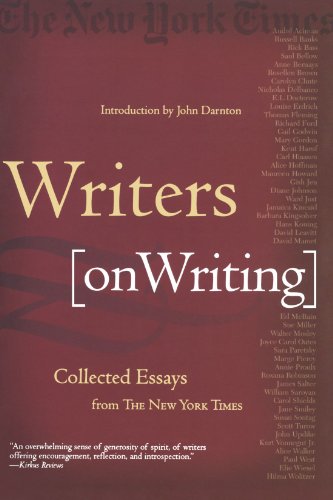
Writers on Writing: Collected Essays from The New York Times Buy on Amazon
Facebook LinkedIn

Writers on Writing: Collected Essays from The New York Times

11.17 17.00 -34% USD

Usually ships in 24 hours

Book Details
Author(s) The New York Times
Publisher Times Books
ISBN / ASIN 0805070850
ISBN-13 9780805070859
Availability Usually ships in 24 hours
Sales Rank #162,110
Marketplace United States 🇺🇸
Ratings & Reviews No reviews yet — be the first!

No reviews yet.

Description
After 30 years as a journalist, John Darnton decided to try his hand at writing a novel. If he wrote 1,000 words a day, he discovered, he'd have a book in a matter of months. But wouldn't it be nice to learn a few tricks of the trade from other writers as well? Thus was born The New York Times's Monday-morning Writers on Writing series. In embarking on the series, says Darnton, he learned that the writers he most wanted to hear from were not necessarily the same ones who most wanted to hear from him. But there couldn't have been too many who turned him down. The 46 columns collected in Writers on Writing are by the likes of Saul Bellow, Mary Gordon, David Mamet, Annie Proulx, Carol Shields, and Paul West. Though many of them have not much more than the occupation "writer" in common, Darnton says that in one way he found them all to be alike: "They wanted to hear, right away, what you thought of their work."

Here, Richard Ford explains why he finds not writing to be a terrific thing. Alice Hoffman describes the effect illness (her own and that of others) has had on her work. Barbara Kingsolver grapples with writing an "unchaste" novel. Louise Erdrich explores the effect a second language, Ojibwe in her case, can have on one's involvement with the first. And Russell Banks learns the hard way that "when you meet a witness to your distant past, your memory tends to improve." The most hilarious piece is Carolyn Chute's "How Can You Create Fiction When Reality Comes to Call?" In it, she describes one day, in which "X-rated stuff happens," the cuckoo clock goes off incessantly, dirty dishes beckon, political cohorts come calling, a dog has a couple of seizures, laundry needs doing, and guests constantly arrive. Once Chute finally does get down to writing, the "n" breaks off the daisy wheel. But at least the phone doesn't ring. "Its bell is broken. It never rings. Thank heavens." --Jane Steinberg

Donate to EbookNetworking
Previous Book Rights of Man (Dover Thrift... Next Book How to Read Literature Like...
Previous Rights of Man (Do...
Next How to Read Liter...
