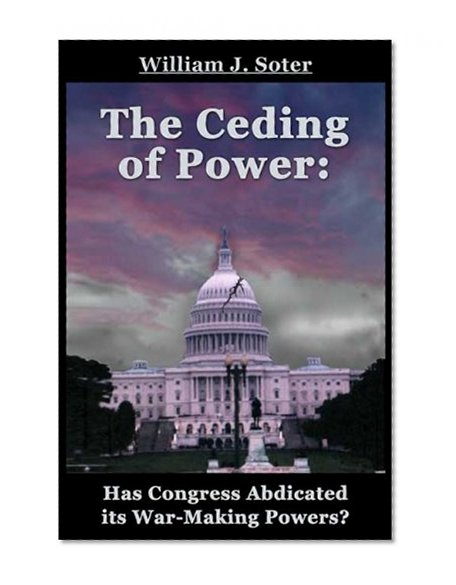


The Ceding of Power: Has Congress Abdicated Its War-Making Powers?
Book Details
Author(s)
William J. Soter
Publisher
Dorrance Publishing Co. Inc.
ISBN / ASIN
0805972412
ISBN-13
9780805972412
Availability
Usually ships in 24 hours
Sales Rank
#8,138,334
Marketplace
United States 🇺🇸
Description
This book is a clarion call for a serious, honest, civil and thorough debate regarding two pivotal questions. First, how are wars initiated in the United States, and second, how the burden of fighting these wars will be shared. Mr. Soter posits that at least two correlative aspects are relevant, one legal and the other moral. Supported by the founding fathers and the fundamental Federalist Papers, the legal question is completely resolved by the written and unamended United States Constitution. The Constitution grants Congress eight specific war powers and the president one separate war power that (except in the case of an emergency) is effective only after Congress has initiated hostilities. The moral question is determined by the time-tested enduring principles of the “just war tradition.†In the ultimate quest for fairness and justice, the author proposes a “bundle of rights†under the heading of a Citizens Bill of Rights during war-time. At least three such rights are included. First, if a war is worth fighting, it is worth the participation of all citizens. Second, if a war is worth fighting, it is worth fighting to win. Finally, if a war is not worth participation of all citizens and it is not worth fighting to win, then by definition the war cannot be a just one, and unjust wars should not be engaged.
At once disparate and connected, other subjects discussed by Mr. Soter include the constructive war-time examples and words of former Presidents Franklin Delano Roosevelt and Dwight D. Eisenhower. Also considered are terrorism and some of its philosophical underpinnings and how terrorism has altered the world landscape. Mr. Soter is deeply troubled by the lack of accountability required by Congress as an institution regarding its constitutional war power obligations. Further, he calls upon the federal judiciary to exercise its independent vast powers of judicial review to help America restore a vital balance in the early stages of the war-making process. Terrorism has been a developing issue in the U.S. at least since 1979 with the dire yet ignored warnings of Senator Henry “Scoop†Jackson, followed by the numerous attacks against U.S. interests in the 1990s. These attacks included two deadly invasions on U.S. soil on February 23, 1993, and on September 11, 2001. Nonetheless! , Congress has sidestepped its Constitutional mandates under Article I, Section 8. The result has been that with Congress’s quiescence the executive branch has usurped Congress’s war powers.
At once disparate and connected, other subjects discussed by Mr. Soter include the constructive war-time examples and words of former Presidents Franklin Delano Roosevelt and Dwight D. Eisenhower. Also considered are terrorism and some of its philosophical underpinnings and how terrorism has altered the world landscape. Mr. Soter is deeply troubled by the lack of accountability required by Congress as an institution regarding its constitutional war power obligations. Further, he calls upon the federal judiciary to exercise its independent vast powers of judicial review to help America restore a vital balance in the early stages of the war-making process. Terrorism has been a developing issue in the U.S. at least since 1979 with the dire yet ignored warnings of Senator Henry “Scoop†Jackson, followed by the numerous attacks against U.S. interests in the 1990s. These attacks included two deadly invasions on U.S. soil on February 23, 1993, and on September 11, 2001. Nonetheless! , Congress has sidestepped its Constitutional mandates under Article I, Section 8. The result has been that with Congress’s quiescence the executive branch has usurped Congress’s war powers.
