Prices are the last we recorded for each Amazon store and change often. Open a market to see its current price.
No reviews yet.
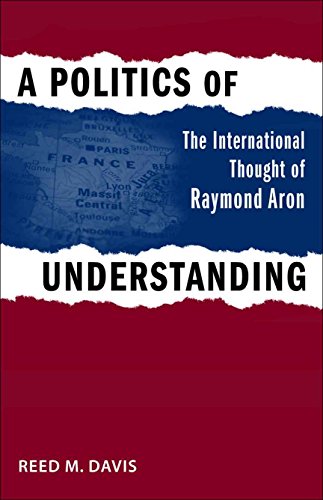
Frequently hailed as one of the greatest defenders of democratic liberalism in postwar Europe, French philosopher, sociologist, and political commentator Raymond Aron (1905--1983) left behind a staggering amount of published work on a remarkably wide range of topics both scholarly and popular. In A Politics of Understanding, Reed M. Davis assesses the originality and consistency of Aron's body of work, drawing a connection between Aron's philosophy of history and three of his abiding interests: the nature of industrial society, international relations theory, and strategic theory.
Davis begins with a brief biography of Aron, known for his skepticism toward political ideologies in the post--World War II era and as an intellectual opponent of Jean-Paul Sartre. After spending three years in Germany in the early 1930s, Aron, a Jew, returned to France in 1933. When war broke out, he fought for a year in the French army and, after the fall of France, escaped to London, where he edited the newspaper of the Free French, La France Libre. He returned to Paris after the war and remained there for the rest of his life, working as a professor and journalist. He wrote an influential political column for Le Figaro for thirty years and authored many books, including The Opium of the Intellectuals (1935), The Algerian Tragedy (1957), and Peace and War (1962).
From World War II onward, Davis shows, Aron sought to construct a science of human action that had as its goal charting the way of human progress in light of two fundamental realities, industrialization and the existence of nuclear weapons. Throughout his long career, he continually asked himself whether human life was becoming better as it became more technologically rationalized and more scientifically advanced. In his close analysis of Aron's thought, Davis carefully describes how Aron fused Max Weber's neo-Kantianism with Edmund Husserl's phenomenology to create an original theory of historical knowledge.
The central theoretical impulse in all of Aron's works, Davis explains, is that of reconciling freedom and necessity. The ways in which Aron attempted to reconcile these two polarities in his earliest writings had a direct bearing on the manner in which he sought to reconcile realism and idealism in his international thought. By attempting to bring reason and necessity into the same loose orbit, Aron tried to construct a theoretical approach to international relations and statecraft that could hold the middle ground between realism and idealism.
Many scholars have simply abandoned efforts to understand the more philosophical dimensions of Aron's thinking because of its technical difficulty. With A Politics of Understanding, Davis provides a concise and clearly written explanation of the basic concepts at work in Aron's philosophy and ties them directly to his later thinking, especially concerning international relations.