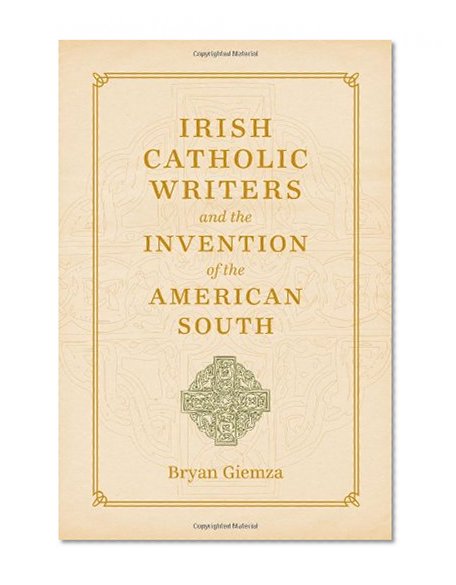


Irish Catholic Writers and the Invention of the American South (Southern Literary Studies)
Price not available for France
You can still browse on Amazon. Try another country above.
Book Details
Author(s)
Bryan A. Giemza
Publisher
Louisiana State University Press
ISBN / ASIN
0807150908
ISBN-13
9780807150900
Marketplace
France 🇫🇷
Ratings & Reviews
No reviews yet — be the first!
No reviews yet.
Description
In this sweeping study, Bryan Giemza retrieves a missing chapter of Irish Catholic heritage by canvassing the literature of American Irish writers from the U.S. South.
From the first Irish American novel, published in Winchester, Virginia, in 1817, Giemza investigates nineteenth-century writers contending with the turbulence of their time writers influenced by both American and Irish revolutions. Additionally, he considers dramatists and propagandists of the Civil War and Lost Cause memoirists who emerged in its wake. Some familiar names arise in an Irish context, including Joel Chandler Harris and Kate (O Flaherty) Chopin. Giemza also examines the works of twentieth-century writers, such as Margaret Mitchell, John Kennedy Toole, and Pat Conroy. For each author, Giemza traces how Catholicism influenced faith and ethnic identity.
Giemza draws on many never-before-seen documents, including authorized material from the correspondence of Cormac McCarthy, interviews from the Irish community of Flannery O Connor s native Savannah, Georgia, and Giemza s own correspondence with writers such as Valerie Sayers and Anne Rice. This lively history prompts a new understanding of how the Irish in the region helped invent a regional mythos, an enduring literature, and a national image.
From the first Irish American novel, published in Winchester, Virginia, in 1817, Giemza investigates nineteenth-century writers contending with the turbulence of their time writers influenced by both American and Irish revolutions. Additionally, he considers dramatists and propagandists of the Civil War and Lost Cause memoirists who emerged in its wake. Some familiar names arise in an Irish context, including Joel Chandler Harris and Kate (O Flaherty) Chopin. Giemza also examines the works of twentieth-century writers, such as Margaret Mitchell, John Kennedy Toole, and Pat Conroy. For each author, Giemza traces how Catholicism influenced faith and ethnic identity.
Giemza draws on many never-before-seen documents, including authorized material from the correspondence of Cormac McCarthy, interviews from the Irish community of Flannery O Connor s native Savannah, Georgia, and Giemza s own correspondence with writers such as Valerie Sayers and Anne Rice. This lively history prompts a new understanding of how the Irish in the region helped invent a regional mythos, an enduring literature, and a national image.
