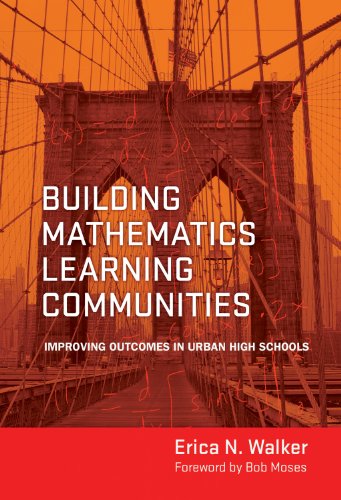


Building Mathematics Learning Communities: Improving Outcomes in Urban High Schools
Book Details
Author(s)Erica N. Walker
PublisherTeachers College Press
ISBN / ASIN0807753289
ISBN-139780807753286
CategoryEducation
MarketplaceIndia 🇮🇳
Description
''Opportunity to learn (OTL) factors interact and ultimately influence mathematics achievement. Many important OTL interactions take place in school settings. This volume provides insights into the role of peer interactions in the mathematics learning process. The analysis describes with a sense of purpose a topic that is typically overlooked in discussions of mathematics reform. The case study is an important contribution to the urban mathematics education literature.''
--William F. Tate,
Edward Mallinckrodt Distinguished University Professor in Arts & Sciences, Washington University in St. Louis
Drawing on perceptions, behaviors, and experiences of students at an urban high school--both high and low achievers--this timely book demonstrates how urban youth can be meaningfully engaged in learning mathematics. The author presents a ''potential'' model rather than a ''deficit'' model, complete with teaching strategies and best practices for teaching mathematics in innovative and relevant ways. This resource offers practical insights for pre- and inservice teachers and administrators on facilitating positive interactions, engagement, and achievement in mathematics, particularly with Black and Latino/a students. It also examines societal perceptions of urban students and how these affect teaching and learning, policies, and mathematics outcomes.
--William F. Tate,
Edward Mallinckrodt Distinguished University Professor in Arts & Sciences, Washington University in St. Louis
Drawing on perceptions, behaviors, and experiences of students at an urban high school--both high and low achievers--this timely book demonstrates how urban youth can be meaningfully engaged in learning mathematics. The author presents a ''potential'' model rather than a ''deficit'' model, complete with teaching strategies and best practices for teaching mathematics in innovative and relevant ways. This resource offers practical insights for pre- and inservice teachers and administrators on facilitating positive interactions, engagement, and achievement in mathematics, particularly with Black and Latino/a students. It also examines societal perceptions of urban students and how these affect teaching and learning, policies, and mathematics outcomes.
More Books in Education



