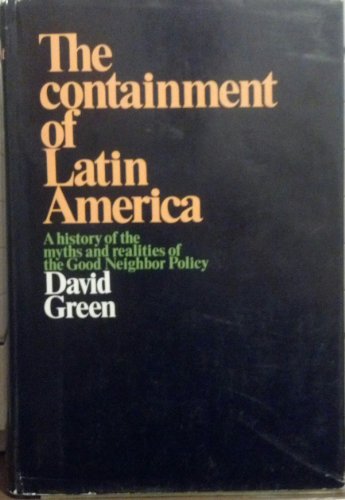


The containment of Latin America;: A history of the myths and realities of the good neighbor policy
Book Details
Author(s)
David Green
Publisher
Quadrangle Books
ISBN / ASIN
0812901606
ISBN-13
9780812901603
Category
Hardcover
Marketplace
United Kingdom 🇬🇧
Description
The Good Neighbor Policy was the foreign policy of the administration of U.S. President Roosevelt toward the countries of Latin America. While its rule became effective during FDR's presidency, Herbert Hoover paved the way for it and coined the term "Good Neighbor". The policy's main principle was that of non-intervention and non-interference in the domestic affairs of Latin America. It also reinforced the idea that the United States would be a "good neighbor" and engage in reciprocal exchanges with Latin American countries. Overall, the Roosevelt administration expected that this new policy would create new economic opportunities in the form of reciprocal trade agreements and reassert the influence of the United States in Latin America. Going beyond the traditional emphasis on FDR's short-term successes, the author, David Green, shows that America's post-1948 policy of containing Latin America sprang from an acceptance, rather than a rejection, of the Good Neighbor Policy; he demonstrates how the U.S. is still locked into the belief that peace in Latin America can be equated with the growth of American power and influence. Above all, as Mr. Green makes clear, the Good Neighbor Policy failed to resolve the crucial conflict between Latin American nationalism and U.S. power. The Containment of Latin America traces the Roosevelt administration's response to pressure and challenges on three levels. On the national level, the Policy was developed as a means for fighting economic depression by promoting U.S. exports to Latin America and encouraging American invest there. On the hemispheric level, the Policy sought to encourage economic ties to overcome political and economic nationalism in Latin America. On the global level, the challenge of fascist and socialist ideologies in Latin America was met with an anti-Axis All-American Front - which after the war became a perfect vehicle for anti-communist militancy. This book sets forth this history in compelling detail.


