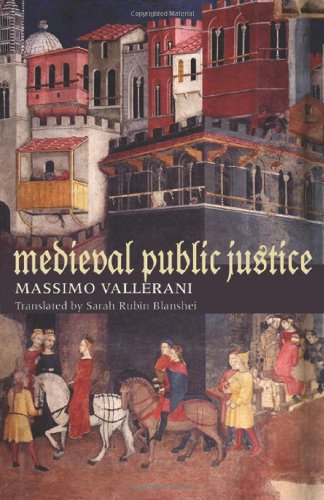


Medieval Public Justice (Cannon Law)
Book Details
Author(s)Massimo Vallerani
ISBN / ASIN081321971X
ISBN-139780813219714
AvailabilityUsually ships in 24 hours
Sales Rank1,666,563
MarketplaceUnited States 🇺🇸
Description
In a series of essays based on surviving documents of actual court practices
from Perugia and Bologna, as well as laws, statutes, and theoretical
works from the 12th and 13th centuries, Massimo Vallerani offers important
historical insights into the establishment of a trial-based public
justice system. Challenging the long-standing evolutionary paradigm of
medieval legal procedures, Vallerani argues that public justice was not
the triumph of strong inquisitorial procedure over weak accusatory procedure,
but rather a process in which the two procedures developed in
tandem. He demonstrates that inquisition and accusation shared many
features in their intertwining goals of punishment and reconciliation.
The grand narrative of the evolution of criminal justice is dismantled
in this work, originally published in Italian and widely cited as a
groundbreaking study of legal procedure. Vallerani contends that accusatio
and inquisitio were formed simultaneously to address different
needs: to seek and construct different "truths" -- the truth of the fact
that occurred outside the courtroom as revealed by the probing of the
judge, and the truth that emerges inside the triadic model of the courtroom
as a result of negotiations between the disputing parties under
the guidance of the judge.
Vallerani's rich approach to his sources includes statistical analysis
of the court records, revealing the functioning of the courts in terms of
the incidence of torture, the proportions of trials initiated by accusatio
and inquisitio, and the percentage of trials suspended at different
stages of litigation. Furthermore, he sets legal procedures within the
context of a society and political world immersed in violence and conflict
and shows how the supplica, or petition for pardon, played a major
role in the transformation from communal to signorial government in
the early fourteenth century.
from Perugia and Bologna, as well as laws, statutes, and theoretical
works from the 12th and 13th centuries, Massimo Vallerani offers important
historical insights into the establishment of a trial-based public
justice system. Challenging the long-standing evolutionary paradigm of
medieval legal procedures, Vallerani argues that public justice was not
the triumph of strong inquisitorial procedure over weak accusatory procedure,
but rather a process in which the two procedures developed in
tandem. He demonstrates that inquisition and accusation shared many
features in their intertwining goals of punishment and reconciliation.
The grand narrative of the evolution of criminal justice is dismantled
in this work, originally published in Italian and widely cited as a
groundbreaking study of legal procedure. Vallerani contends that accusatio
and inquisitio were formed simultaneously to address different
needs: to seek and construct different "truths" -- the truth of the fact
that occurred outside the courtroom as revealed by the probing of the
judge, and the truth that emerges inside the triadic model of the courtroom
as a result of negotiations between the disputing parties under
the guidance of the judge.
Vallerani's rich approach to his sources includes statistical analysis
of the court records, revealing the functioning of the courts in terms of
the incidence of torture, the proportions of trials initiated by accusatio
and inquisitio, and the percentage of trials suspended at different
stages of litigation. Furthermore, he sets legal procedures within the
context of a society and political world immersed in violence and conflict
and shows how the supplica, or petition for pardon, played a major
role in the transformation from communal to signorial government in
the early fourteenth century.
