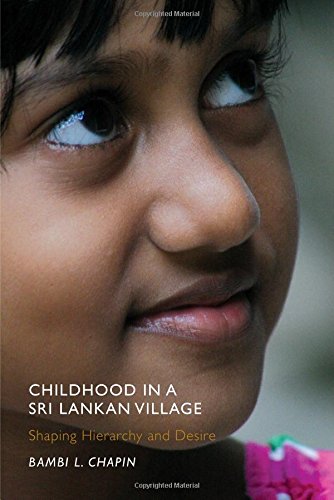


Childhood in a Sri Lankan Village: Shaping Hierarchy and Desire (Series in Childhood Studies)
Book Details
Author(s)
Bambi L. Chapin
Publisher
Rutgers University Press
ISBN / ASIN
0813561663
ISBN-13
9780813561660
Availability
Usually ships in 24 hours
Sales Rank
#8,426,222
Marketplace
United States 🇺🇸
Ratings & Reviews
No reviews yet — be the first!
No reviews yet.
Description
Like toddlers all over the world, Sri Lankan children go through a period that in the U.S. is referred to as the “terrible twos.†Yet once they reach elementary school age, they appear uncannily passive, compliant, and undemanding compared to their Western counterparts. Clearly, these children have undergone some process of socialization, but what?
Over ten years ago, anthropologist Bambi Chapin traveled to a rural Sri Lankan village to begin answering this question, getting to know the toddlers in the village, then returning to track their development over the course of the following decade. Childhood in a Sri Lankan Village offers an intimate look at how these children, raised on the tenets of Buddhism, are trained to set aside selfish desires for the good of their families and the community. Chapin reveals how this cultural conditioning is carried out through small everyday practices, including eating and sleeping arrangements, yet she also explores how the village’s attitudes and customs continue to evolve with each new generation.
Combining penetrating psychological insights with a rigorous observation of larger social structures, Chapin enables us to see the world through the eyes of Sri Lankan children searching for a place within their families and communities. Childhood in a Sri Lankan Village offers a fresh, global perspective on child development and the transmission of culture.   Â
Over ten years ago, anthropologist Bambi Chapin traveled to a rural Sri Lankan village to begin answering this question, getting to know the toddlers in the village, then returning to track their development over the course of the following decade. Childhood in a Sri Lankan Village offers an intimate look at how these children, raised on the tenets of Buddhism, are trained to set aside selfish desires for the good of their families and the community. Chapin reveals how this cultural conditioning is carried out through small everyday practices, including eating and sleeping arrangements, yet she also explores how the village’s attitudes and customs continue to evolve with each new generation.
Combining penetrating psychological insights with a rigorous observation of larger social structures, Chapin enables us to see the world through the eyes of Sri Lankan children searching for a place within their families and communities. Childhood in a Sri Lankan Village offers a fresh, global perspective on child development and the transmission of culture.   Â
