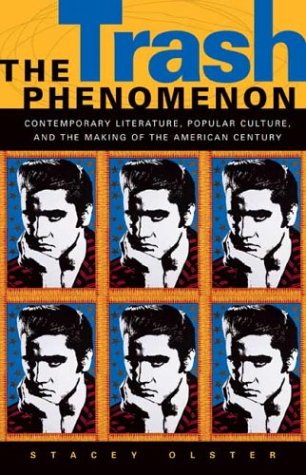


The Trash Phenomenon: Contemporary Literature, Popular Culture, and the Making of the American Century
Book Details
Description
The Trash Phenomenon begins with a look at the mass media's role in the United States' emergence as the twentieth century's dominant power. Olster discusses the works of three authors who collectively span the century bounded by the Spanish-American War (1898) and the Persian Gulf War (1991): Gore Vidal's American Chronicle series, John Updike's Rabbit tetralogy, and Larry Beinhart's American Hero. Olster then turns her attention to three non-American writers whose works explore the imperial sway of American popular culture on their nation's value systems: hierarchical class structure in Dennis Potter's England, Peronism in Manuel Puig's Argentina, and Nihonjinron consensus in Haruki Murakami's Japan.
Finally, Olster returns to American literature to look at the contemporary media spectacle and the representative figure as potential sources of national consolidation after November 1963. Olster first focuses on autobiographical, historical, and fictional accounts of three spectacles in which the formulae of popular culture are shown to bypass differences of class, gender, and race: the John F. Kennedy assassination, the Scarsdale Diet Doctor murder, and the O. J. Simpson trial. She concludes with some thoughts about the nature of American consolidation after 9/11.
More Books by Stacey Olster

