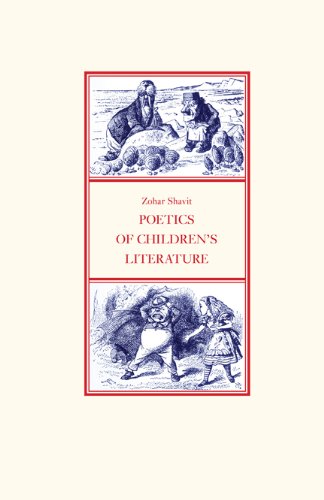


Poetics of Children's Literature
Book Details
Author(s)Zohar Shavit
PublisherUniversity of Georgia Press
ISBN / ASIN0820334812
ISBN-139780820334813
AvailabilityUsually ships in 24 hours
Sales Rank3,646,502
MarketplaceUnited States 🇺🇸
Description
Since its emergence in the seventeenth century as a distinctive cultural system, children’s literature has had a culturally inferior status resulting from its existence in a netherworld between the literary system and the educational system. In addition to its official readership—children—it has to be approved of by adults. Writers for children, explains Zohar Shavit, are constrained to respond to these multiple systems of often mutually contradictory demands. Most writers do not try to bypass these constraints, but accept them as a framework for their work. In the most extreme cases an author may ignore one segment of the readership. If the adult reader is ignored, the writer risks rejection, as is the case of popular literature. If the writer utilizes the child as a pseudo addressee in order to appeal to an adult audience, the result can be what Shavit terms an ambivalent work. Â
Shavit analyzes the conventions and the moral aims that have structured children’s literature, from the fairy tales collected and reworked by Charles Perrault and the Brothers Grimm—in particular, “Little Red Riding Hoodâ€â€”through the complex manipulations of Lewis Carroll in Alice’s Adventures in Wonderland, to the subversion of the genre’s canonical requirements in the chapbooks of the eighteenth century, and in the formulaic Nancy Drew books of the twentieth century. Throughout her study Shavit, explores not only how society has shaped children’s literature, but also how society has been reflected in the literary works it produces for its children.
Shavit analyzes the conventions and the moral aims that have structured children’s literature, from the fairy tales collected and reworked by Charles Perrault and the Brothers Grimm—in particular, “Little Red Riding Hoodâ€â€”through the complex manipulations of Lewis Carroll in Alice’s Adventures in Wonderland, to the subversion of the genre’s canonical requirements in the chapbooks of the eighteenth century, and in the formulaic Nancy Drew books of the twentieth century. Throughout her study Shavit, explores not only how society has shaped children’s literature, but also how society has been reflected in the literary works it produces for its children.
