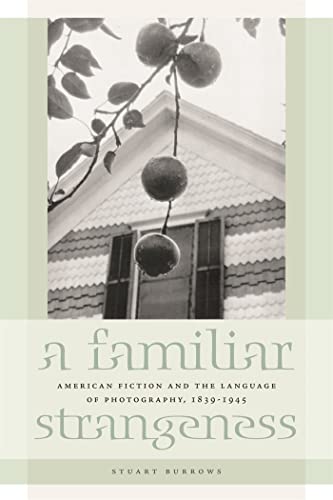
A Familiar Strangeness: American Fiction and the Language of Photography, 1839-1945 Buy on Amazon
Facebook LinkedIn

A Familiar Strangeness: American Fiction and the Language of Photography, 1839-1945

Price not available for France

You can still browse on Amazon. Try another country above.

Book Details
Author(s) Stuart Burrows
ISBN / ASIN 0820335215
ISBN-13 9780820335216
Marketplace France 🇫🇷
Ratings & Reviews No reviews yet — be the first!

No reviews yet.

Description
Literary critics have traditionally suggested that the invention of photography led to the rise of the realist novel, which is believed to imitate the detail and accuracy of the photographic image. Instead, says Stuart Burrows, photography's influence on American fiction had less to do with any formal similarity between the two media than with the capacity of photography to render American identity and history homogeneous and reproducible. The camera, according to Burrows, provoked a representational crisis, one broadly modernist in character. Since the photograph is not only a copy of its subject but a physical product of it, the camera can be seen as actually challenging mimetic or realistic theories of representation, which depend on a recognizable gap between original and reproduction.

Burrows argues for the centrality of photography to a set of writers commonly thought of as hostile to the camera-including Nathaniel Hawthorne, Henry James, William Faulkner, and Zora Neale Hurston. The photographic metaphors and allusions to the medium that appear throughout these writers' work demonstrate the ways in which one representational form actually influences another—by changing how artists conceive of identity, history, and art itself.

A Familiar Strangeness thus challenges the notion of an absolute break between nineteenth-century realism and twentieth-century modernism, a break that typically centers precisely on the two movements' supposedly differing relation to the camera. Just as modernist fiction interrupts and questions the link between visuality and knowledge, so American realist fiction can be understood as making the world less knowable precisely by making it more visible.

Donate to EbookNetworking
Previous Book Next Book
Previous
Next
