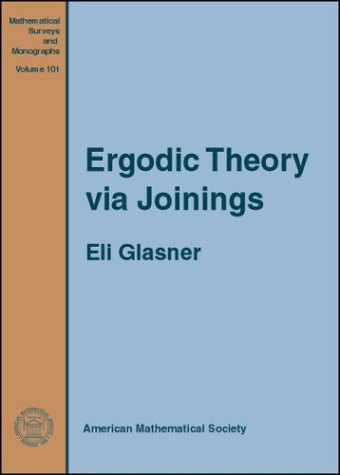


Ergodic Theory via Joinings (Mathematical Surveys and Monographs, No. 101)
Price not available for France
You can still browse on Amazon. Try another country above.
Book Details
Author(s)
Eli Glasner
Publisher
Amer Mathematical Society
ISBN / ASIN
0821833723
ISBN-13
9780821833728
Category
Mathematics
Marketplace
France 🇫🇷
Ratings & Reviews
No reviews yet — be the first!
No reviews yet.
Description
This book introduces modern ergodic theory. It emphasizes a new approach that relies on the technique of joining two (or more) dynamical systems. This approach has proved to be fruitful in many recent works, and this is the first time that the entire theory is presented from a joining perspective. Another new feature of the book is the presentation of basic definitions of ergodic theory in terms of the Koopman unitary representation associated with a dynamical system and the invariant mean on matrix coefficients, which exists for any acting groups, amenable or not. Accordingly, the first part of the book treats the ergodic theory for an action of an arbitrary countable group. The second part, which deals with entropy theory, is confined (for the sake of simplicity) to the classical case of a single measure-preserving transformation on a Lebesgue probability space.Topics treated in the book include: the interface between topological dynamics and ergodic theory; the theory of distal systems due to H. Furstenberg and R. Zimmer - presented for the first time in monograph form; B. Host's solution of Rohlin's question on the mixing of all orders for systems with singular spectral type; the theory of simple systems; a dynamical characterization of Kazhdan groups; Weiss' relative version of the Jewett-Krieger theorem; Ornstein's isomorphism theorem; and, a local variational principle and its applications to the theory of entropy pairs.The book is intended for graduate students who have a good command of basic measure theory and functional analysis and who would like to master the subject. It contains many detailed examples and many exercises, usually with indications of solutions. It can serve equally well as a textbook for graduate courses, for independent study, supplementary reading, or as a streamlined introduction for non-specialists who wish to learn about modern aspects of ergodic theory.


