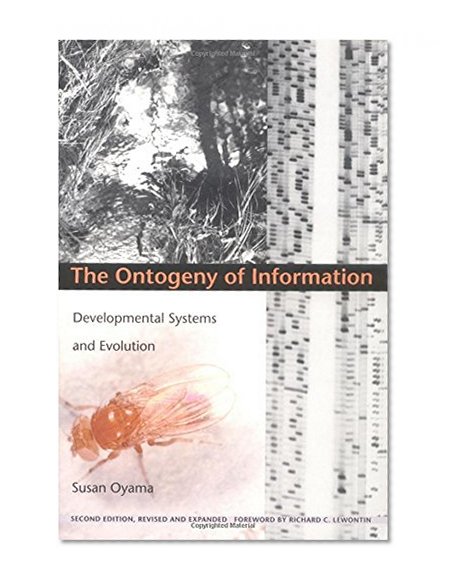


The Ontogeny of Information: Developmental Systems and Evolution (Science and Cultural Theory)
Book Details
Author(s)Susan Oyama
PublisherDuke University Press Books
ISBN / ASIN0822324660
ISBN-139780822324669
AvailabilityUsually ships in 24 hours
Sales Rank545,020
MarketplaceUnited States 🇺🇸
Description
The Ontogeny of Information is a critical intervention into the ongoing and perpetually troubling nature-nurture debates surrounding human development. Originally published in 1985, this was a foundational text in what is now the substantial field of developmental systems theory. In this revised edition Susan Oyama argues compellingly that nature and nurture are not alternative influences on human development but, rather, developmental products and the developmental processes that produce them.
Information, says Oyama, is thought to reside in molecules, cells, tissues, and the environment. When something wondrous occurs in the world, we tend to question whether the information guiding the transformation was pre-encoded in the organism or installed through experience or instruction. Oyama looks beyond this either-or question to focus on the history of such developments. She shows that what developmental “information†does depends on what is already in place and what alternatives are available. She terms this process “constructive interactionism,†whereby each combination of genes and environmental influences simultaneously interacts to produce a unique result. Ontogeny, then, is the result of dynamic and complex interactions in multileveled developmental systems.
The Ontogeny of Information challenges specialists in the fields of developmental biology, philosophy of biology, psychology, and sociology, and even nonspecialists, to reexamine the existing nature-nurture dichotomy as it relates to the history and formation of organisms.
Information, says Oyama, is thought to reside in molecules, cells, tissues, and the environment. When something wondrous occurs in the world, we tend to question whether the information guiding the transformation was pre-encoded in the organism or installed through experience or instruction. Oyama looks beyond this either-or question to focus on the history of such developments. She shows that what developmental “information†does depends on what is already in place and what alternatives are available. She terms this process “constructive interactionism,†whereby each combination of genes and environmental influences simultaneously interacts to produce a unique result. Ontogeny, then, is the result of dynamic and complex interactions in multileveled developmental systems.
The Ontogeny of Information challenges specialists in the fields of developmental biology, philosophy of biology, psychology, and sociology, and even nonspecialists, to reexamine the existing nature-nurture dichotomy as it relates to the history and formation of organisms.
More Books by Susan Oyama

