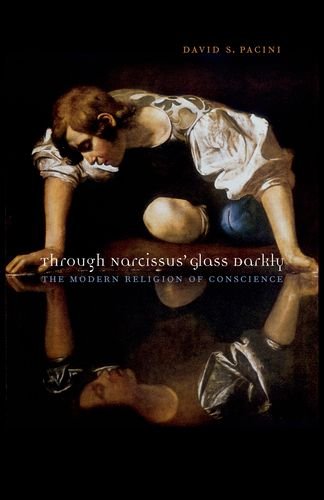


Through Narcissus' Glass Darkly: The Modern Religion of Conscience
Book Details
Author(s)
David Pacini
Publisher
Fordham University Press
ISBN / ASIN
0823229653
ISBN-13
9780823229659
Availability
Usually ships in 24 hours
Sales Rank
#1,004,354
Marketplace
United States 🇺🇸
Ratings & Reviews
No reviews yet — be the first!
No reviews yet.
Description
Through Narcissus' Glass Darkly presents a genealogy and critique of the ideal of conscience in modern philosophical theology, particularly in the writings of Hobbes, Rousseau, and Kant. It shows why the apparently emancipatory rejection of heteronomy compromised the ideal of self-legislated freedom.
David Pacini argues that, despite its advocacy of the popular political value of common understanding, the modern religion of conscience has become the Achilles' heel of both Kantian and Freudian thought. It is doomed to succumb to its own fundamentally narcissistic or self-relating orientation. Avoiding the tenacious cliché that the luminaries of modern philosophy simply replaced God with the self, David Pacini argues that the modern religion of conscience emerges out of a far more radical kind of disenchantment, one in which both God and self are de-divinized. Bereft of divinity, the God of modernity becomes empty; the self of modernity, in its autonomy, becomes hopelessly tied to dissociation from origins and to loss of a world.
Left only to itself, the conscientious individual has only the world it legitimates through self-relating. But given that any other world is inconceivable, the conscientious individual can never know whether its world is just or merely the expression of self-interest. Paradoxically, Pacini argues, the most formidable proponents of the modern religion of conscience share with their critics a common problem: the self-legislating self has become both indispensable and impossible within much of modern philosophy and theology. This unique and interdisciplinary interpretation of conscience makes an important contribution for scholars and students of modern philosophy, Christian theology, psychoanalytic theory, and literary criticism.
David Pacini argues that, despite its advocacy of the popular political value of common understanding, the modern religion of conscience has become the Achilles' heel of both Kantian and Freudian thought. It is doomed to succumb to its own fundamentally narcissistic or self-relating orientation. Avoiding the tenacious cliché that the luminaries of modern philosophy simply replaced God with the self, David Pacini argues that the modern religion of conscience emerges out of a far more radical kind of disenchantment, one in which both God and self are de-divinized. Bereft of divinity, the God of modernity becomes empty; the self of modernity, in its autonomy, becomes hopelessly tied to dissociation from origins and to loss of a world.
Left only to itself, the conscientious individual has only the world it legitimates through self-relating. But given that any other world is inconceivable, the conscientious individual can never know whether its world is just or merely the expression of self-interest. Paradoxically, Pacini argues, the most formidable proponents of the modern religion of conscience share with their critics a common problem: the self-legislating self has become both indispensable and impossible within much of modern philosophy and theology. This unique and interdisciplinary interpretation of conscience makes an important contribution for scholars and students of modern philosophy, Christian theology, psychoanalytic theory, and literary criticism.
