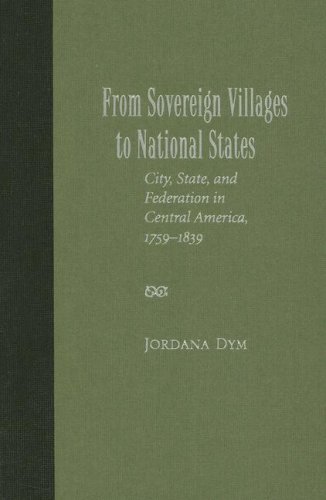


From Sovereign Villages to National States: City, State, and Federation in Central America, 1759-1839
Book Details
Description
The role of the city--as an institution, as a political ideal, as a training ground for politicians--has been neglected in historical studies of Spanish American independence. Connecting the political changes of the Bourbon Reforms (1759-1788) and constitutional monarchy (1808-1821) to those of the independence era (1821-1839), Jordana Dym's analysis of Central America's early nineteenth-century politics shows nation-state formation to be a city-driven process that transformed colonial provinces (weak administrative districts with ambiguous political identities and divided interiors) into enduring states with basic governments and articulated national identities.
Dym argues that in Central America, an important aspect of the nineteenth-century political revolution was a shift from European political ideology based on municipal sovereignty (that of the pueblos) to a politics of national sovereignty (that of the pueblo). The tensions in the move from municipal to national sovereignty, she finds, contributed to multiple civil wars and to the difficulty of bringing breakaway regions to respect colonial districts and capitals. This book challenges the received wisdom that states emerged, already formed, from the process of independence.
Based on extensive research in national and local archives in Central America, the United States, and Europe, this political history examines a complex process that takes into account cooperation as well as conflict between elites and popular groups. It holds that the contradictory, multifaceted republican processes of independence and subsequent efforts at state formation owed much to and must be analyzed within the context of the specific types of political change introduced in the late colonial period, a question of interest to scholars and students of Central America, Mexico, and South America.
