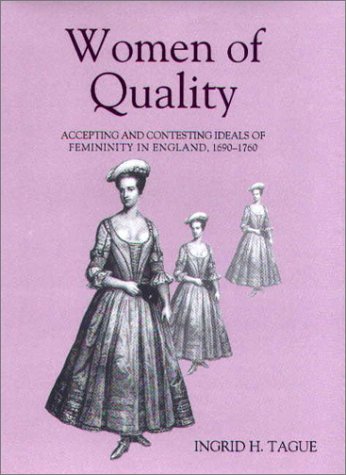


Women of Quality: Accepting and Contesting Ideals of Femininity in England, 1690-1760 (Studies in Early Modern Cultural, Political, and Social History: ... Cultural, Political and Social History)
Book Details
Author(s)
Ingrid H. Tague
Publisher
Boydell Press
ISBN / ASIN
0851159079
ISBN-13
9780851159072
Availability
Usually ships in 24 hours
Sales Rank
#6,119,245
Marketplace
United States 🇺🇸
Ratings & Reviews
No reviews yet — be the first!
No reviews yet.
Description
Focusing on the complex relationship between discourse and experience, Women of Quality examines the role of gender in aristocratic women's daily lives during a period of significant cultural change. In the years following the Glorious Revolution, didactic writers and other social critics responded to a perceived crisis of gender relations by creating a new discourse of 'natural' feminine behavior in opposition to the luxury and decadence of fashionable women. Modern scholars have often portrayed this agenda as representing the rise of a middle-class ideology, but Ingrid Tague argues that the new rhetoric held enormous appeal for those women who would appear to be its greatest targets: wealthy, fashionable 'women of quality'. Using the correspondence and diaries of these women, Tague traces the ways in which they adopted, adapted, and exploited ideals of femininity. In their hands, feminine values could become powerful tools that enabled them to compete for status and reputation. Ironically, by identifying femininity with private, trivial concerns, these ideals created unique opportunities for elite women. Female participation in informal social and political activities placed women at the heart of aristocratic power in the early eighteenth century, even as they employed the language of wifely subordination and domesticity.

